Ready to buy rather than research? See where to buy a crocodile Hermes in London — our exotic pieces with open prices. The exotic-skin Hermès bag is the most misunderstood object in the maison's catalogue. It is more expensive than a townhouse deposit, harder to source than a Michelin table, and — for the client who understands it — one of the very few luxury objects that has genuinely retained purchasing power against a decade of monetary inflation.
This is a guide to the four exotic skins Hermès currently offers — Niloticus crocodile, Porosus crocodile, Mississippi alligator, and lizard — with a note on ostrich, which sits in a separate category. It covers the visual differences, the CITES paperwork, the care realities, the prices, and what a client should think about before spending in this range. It also covers what to inspect before writing a cheque for £60,000+ on a pre-owned Kelly.
Every observation here comes from the JULL Chelsea Harbour stock room, from London auction attendance, and from clients who have moved into and out of exotic pieces over the last three years. Prices and demand patterns quoted are Q3 2026.
What Hermès means when it says "exotic"
Hermès uses "exotic" to describe skins that are not standard-issue calf, goat, or ostrich-classified. In practice this means three families:
- Crocodilian family — Niloticus crocodile, Porosus crocodile, Mississippi alligator. - Lizard — Salvator lizard (the smaller-scaled skin used on Kelly Longue wallets and Mini Kellys). - Ostrich — often lumped with exotics colloquially, but Hermès catalogues it separately.
Each has a different scale pattern, a different atelier discipline, and a different price band. All are legal for international sale under CITES (the Convention on International Trade in Endangered Species) with the appropriate paperwork, which Hermès issues at point of sale and which we transfer with the bag at JULL.
Niloticus crocodile: Nile crocodile, the largest scales
Niloticus (Crocodylus niloticus) is the freshwater Nile crocodile, farmed principally in Zimbabwe and, to a smaller degree, in South Africa. Its skin is the largest-scaled of the Hermès crocodilians: symmetrical, roundish tiles running down the centre of the belly, with wider tiles at the flank.
Niloticus is the Hermès exotic that most people picture when they think of "an Hermès crocodile Birkin." It comes in two finishes: Lisse (glossy, hand-lacquered) and Mat (matte, unlacquered). The Lisse finish is more common; the Mat, particularly in dark colours like Rouge H, Noir, and Marron, is rarer and — in our showroom — moves faster.
Retail on a new Niloticus Lisse Birkin 30 with palladium hardware in 2026 sits at approximately £52,000 to £58,000 depending on colour. A Niloticus Mat Kelly 25 Sellier in a rare colour with GHW retails closer to £60,000 to £68,000. Pre-owned market on both, for pieces in immaculate condition, sits at 90–110% of retail — the plus-side of retail arises when a colour or hardware combination has become discontinued between purchase and resale.
Niloticus is the exotic most commonly commissioned via SO (Special Order). SO Nilos take 18–36 months and rarely appear on the secondary market before eight years of ownership.
Porosus crocodile: the smaller, more valuable saltwater scale
Porosus (Crocodylus porosus) is the saltwater crocodile — larger animal, but smaller and tighter scales — farmed principally in Australia and Papua New Guinea. Because Porosus animals are larger but yield a tighter scale pattern with more visible symmetry, Porosus skins are considered more valuable per square centimetre than Niloticus.
The visual tell is the umbilical scute — the dot on the underside of a Porosus scale that Niloticus does not display. On a Birkin flap, look at the very central line of scales: on Porosus, you will see a fine dot in the middle of each central tile. This is the mark of the skin.
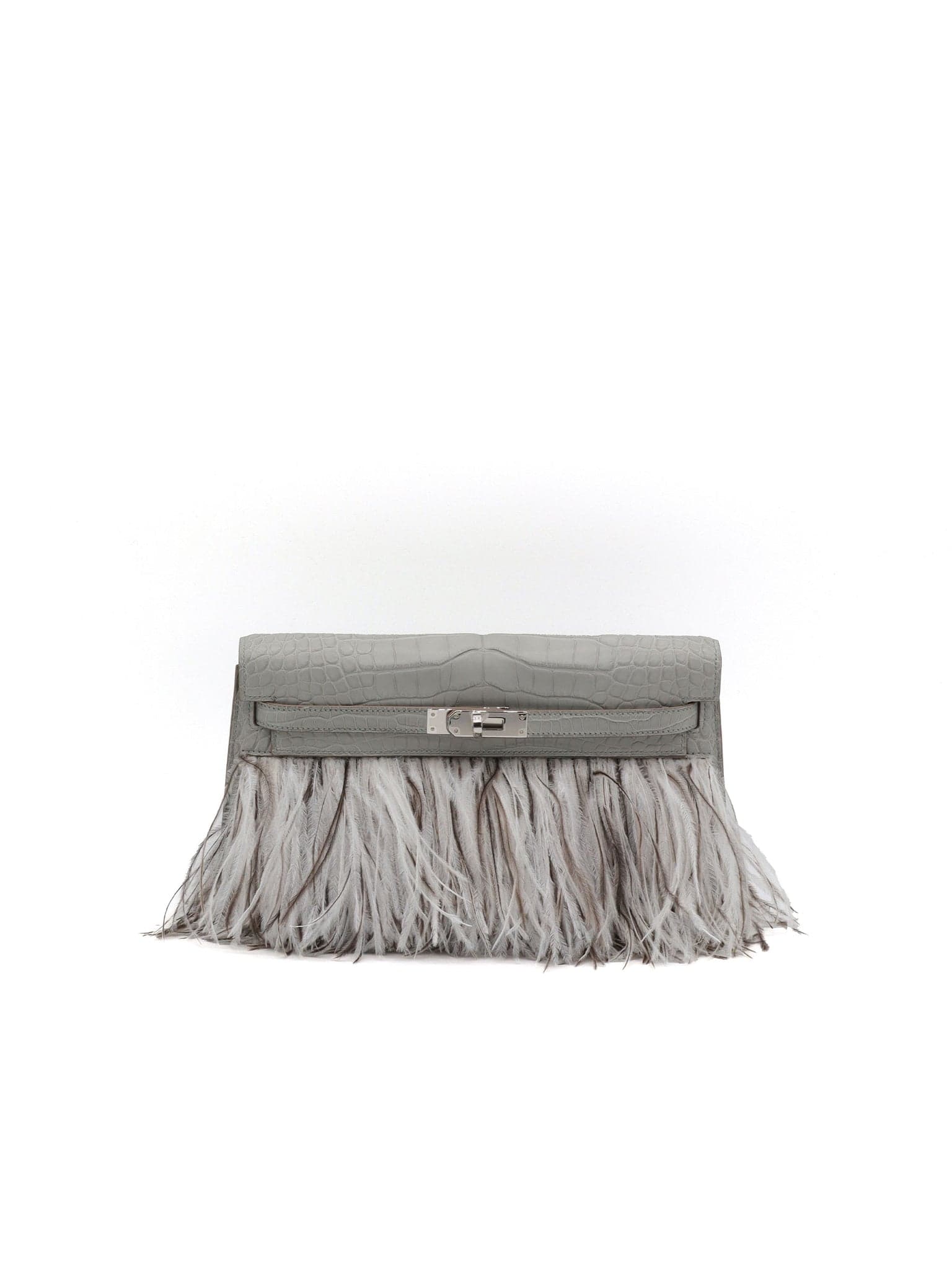
Porosus is the more expensive of the two crocodile options. New retail on a Porosus Lisse Birkin 30 sits at approximately £58,000 to £66,000. A Porosus Shiny Birkin 25 in a rare colour — Rose Sakura, Vert Emeraude, Bleu Marine — can retail at £62,000 and trade pre-owned above retail for many years. The Kelly Elan Sellier in Porosus Shiny Alligator (a variant we currently hold at £77,500 in black with palladium) is a piece that will not appear at boutique except through Special Order and represents the top of the Hermès evening-bag category.
Porosus Mat is the rarest of the crocodilians. If you find a Porosus Mat in Rouge Sellier or Vert Bengale, buy it.
Mississippi alligator: the American exotic
Mississippi alligator (Alligator mississippiensis) is the American southern-farmed exotic. It has a distinct visual pattern from either crocodile: less symmetrical scale distribution, a broader "belly" area with squarer tiles, and — most importantly — no umbilical scutes.
Alligator has become, over the last five years, the fastest-growing category in Hermès's exotic allocations. Two reasons: farming ethics in the US are more transparent than in some crocodile jurisdictions, and the aesthetic of the alligator scale — slightly less "perfect" than Porosus — has come to feel more contemporary among younger collectors.
New retail on an Alligator Shiny Birkin 30 with GHW in 2026 sits at approximately £48,000 to £54,000. Kelly Sellier 28 in Alligator Mat retails at £52,000 to £58,000. Pre-owned market on alligator sits at 85–100% of retail, with rarer colours in Mat finish exceeding retail on resale.
Because alligator is easier to source than Porosus, it is the exotic most likely to be offered at boutique to newer VIP clients as a stepping-stone into the exotic category. A first exotic Kelly in Alligator Mat, Rouge Vermillon, is a not-uncommon Hermès first-exotic story.
Lizard: Salvator, small scales, smaller bags
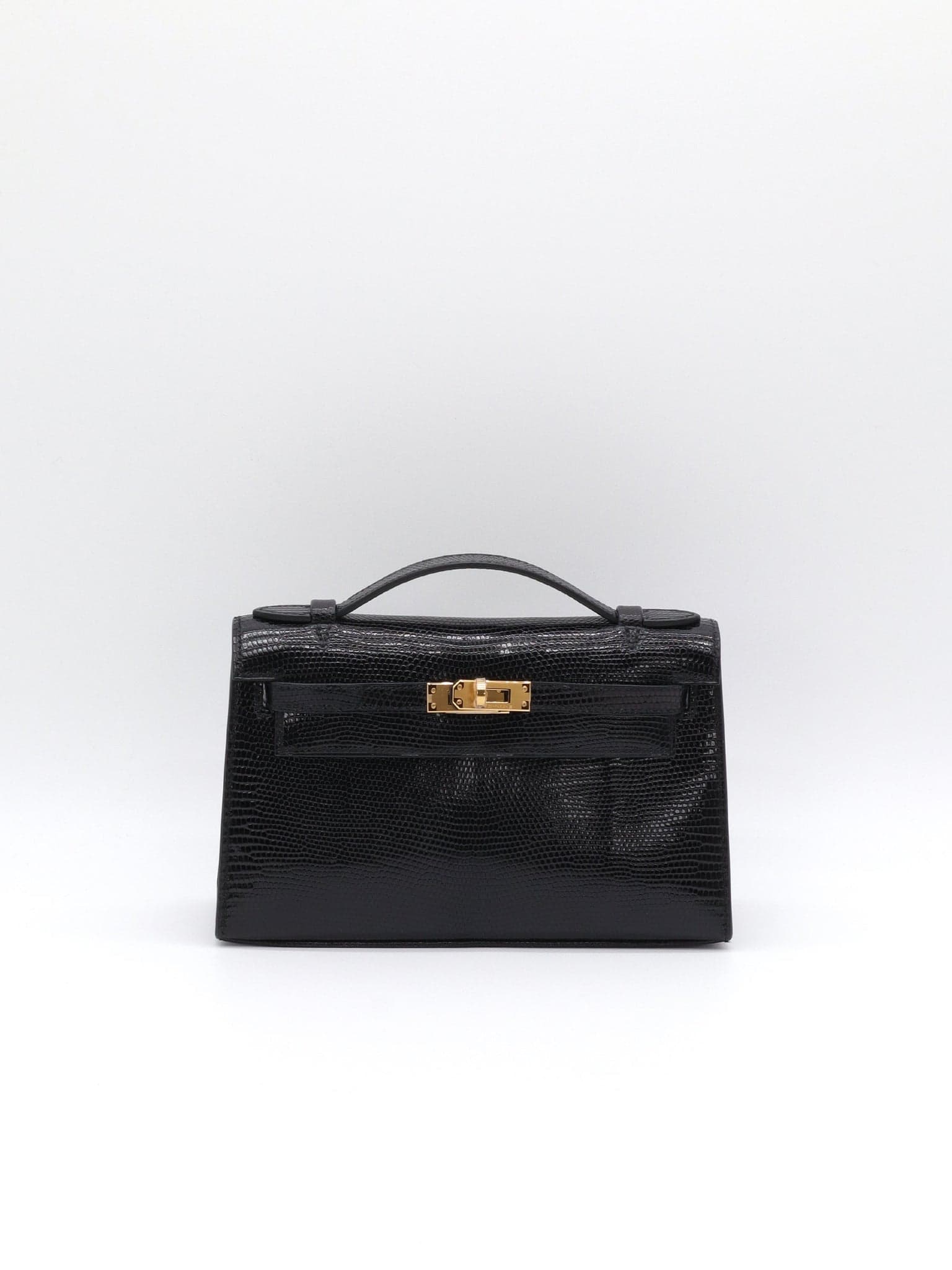
Lizard (Varanus salvator) is the Salvator monitor, farmed in Malaysia and Indonesia. Its scale is the smallest of the Hermès exotics — a fine, semi-geometric pattern that reads at close range as delicate rather than reptilian.
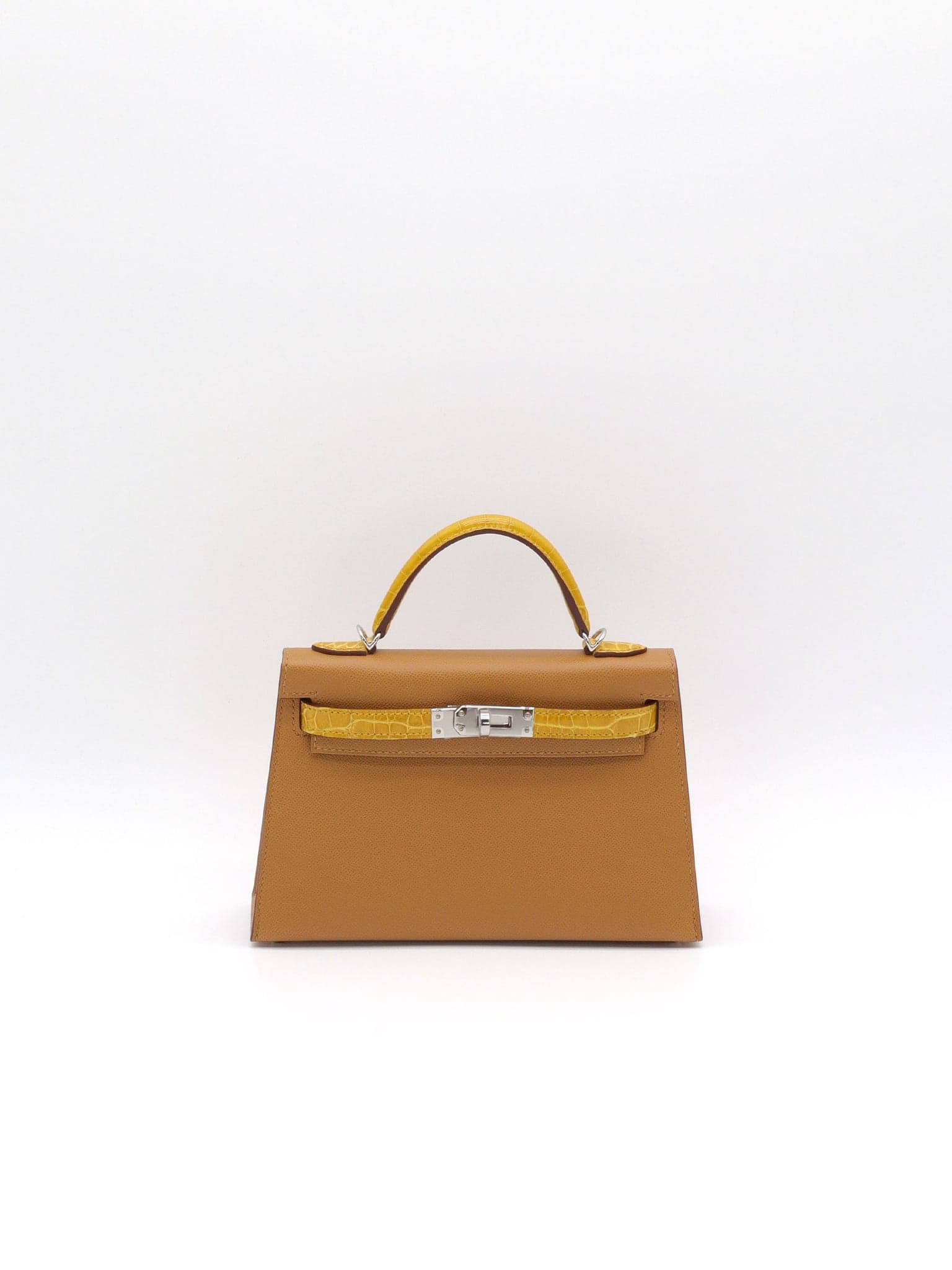
Lizard is used almost exclusively on smaller pieces: Kelly 20, Kelly 25, Kelly Longue wallets, Mini Kelly, Constance Mini, and the smaller Bearn wallets. It does not scale up to a Birkin 35 — the animal simply does not yield enough contiguous skin.
Retail on a Lizard Mini Kelly in 2026 sits at approximately £32,000 to £38,000. A Kelly 20 in Vert Ombre Lizard with palladium retails at £42,000+. Pre-owned market on lizard is thin — there simply aren't many pieces in circulation — and, when a piece surfaces, it typically transacts within days.
The lizard Mini Kelly in Rouge Grenat with GHW is, in our view, the most under-photographed Hermès piece of the last decade. It is worth searching for.
Ostrich: exotic-adjacent, worn hard
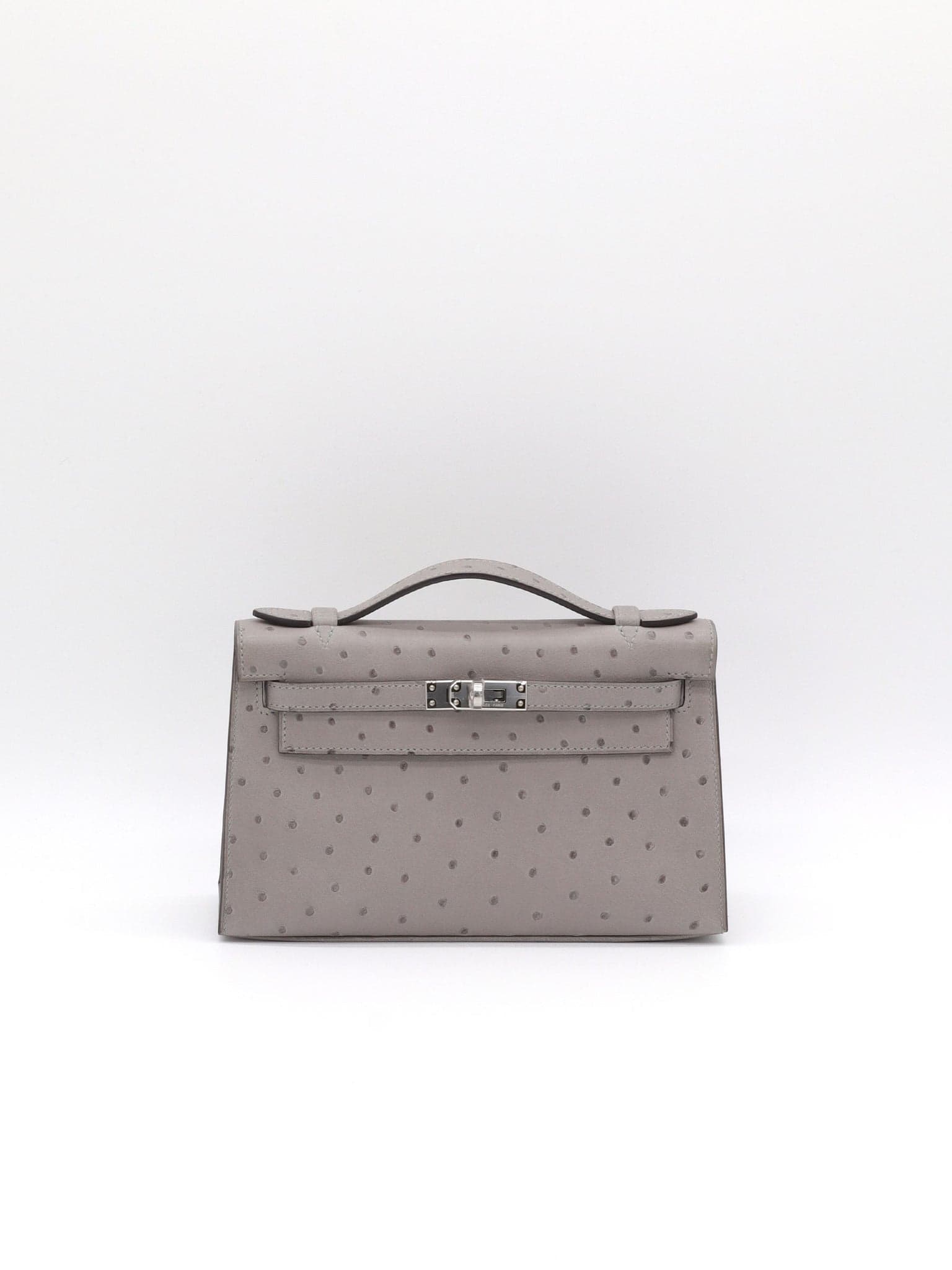
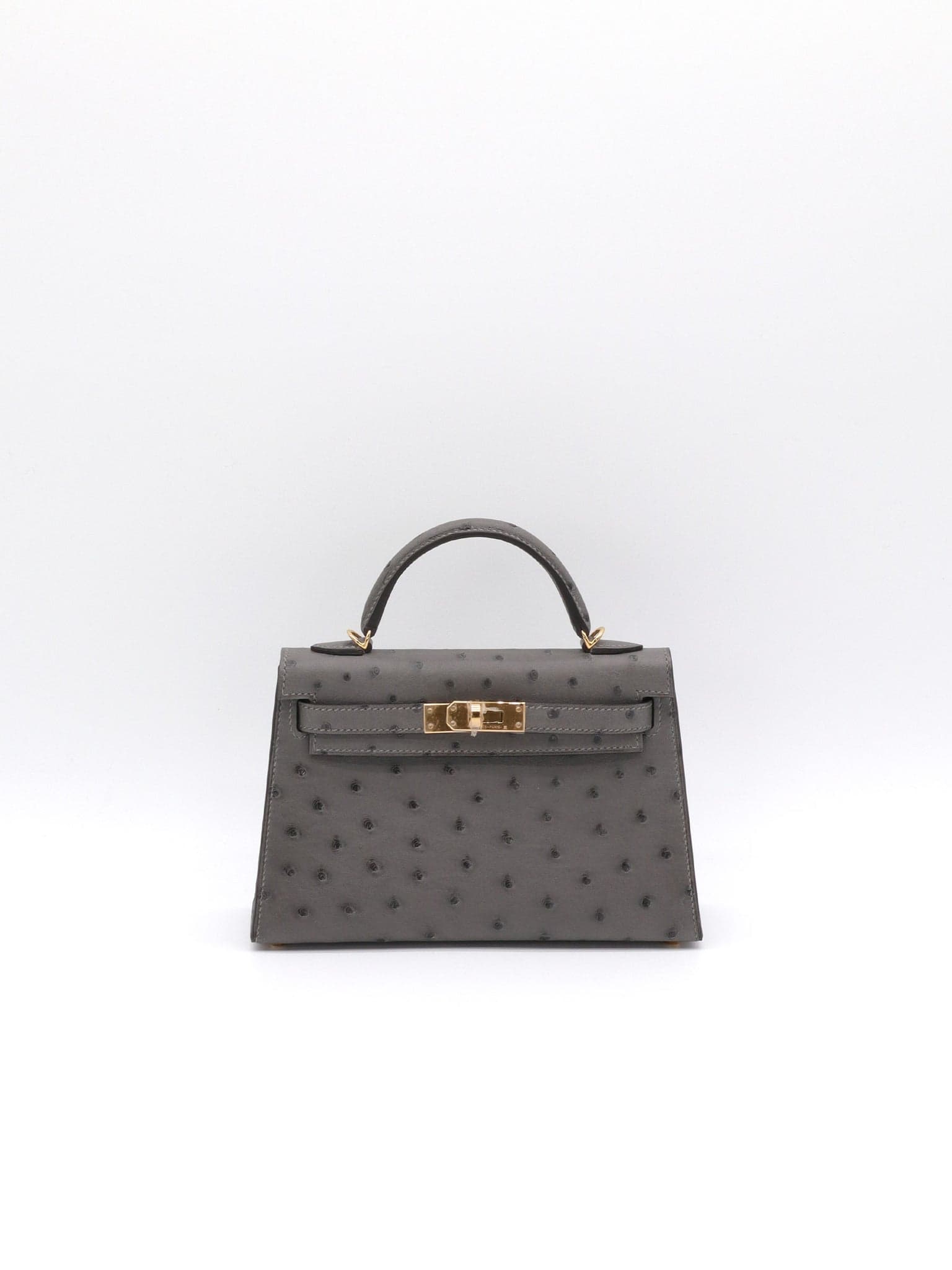
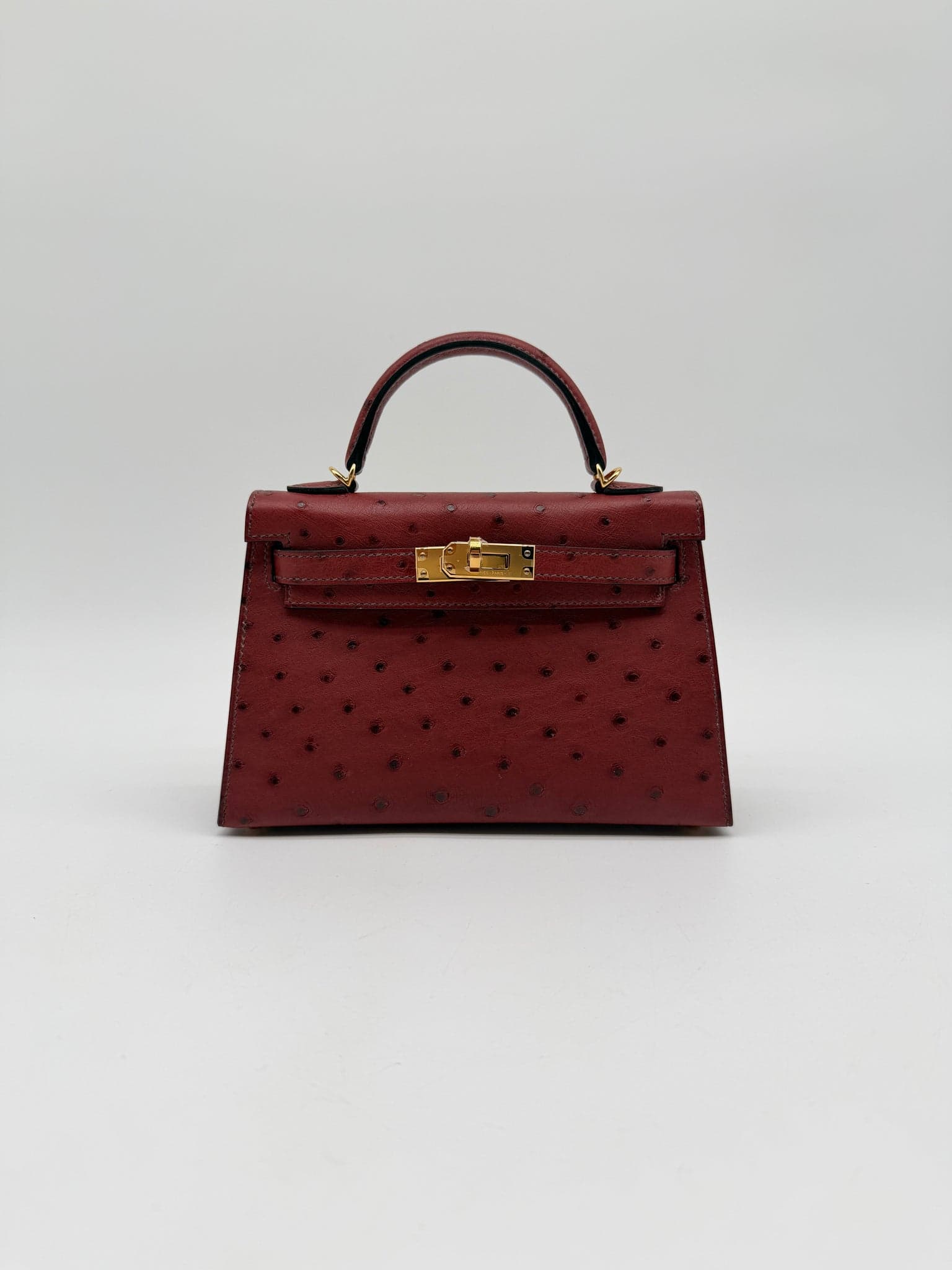
Ostrich (Struthio camelus) sits, technically, outside the CITES exotic classification, but Hermès treats it as an exotic in price and in allocation. The visual signature is the quill follicle — the small raised dots across the skin — which reads either as texture or as blemish depending on the observer.
Ostrich is farmed principally in South Africa. Hermès uses the mid-body skin, which has the most consistent follicle distribution. Ostrich is durable in a way the crocodilians are not: it can be scratched, dropped, and re-worked without the visible damage a crocodile flap would show. This makes it the exotic-category Hermès bag most likely to be worn every day.
Retail on an Ostrich Birkin 30 in 2026 sits at approximately £22,000 to £28,000. Pre-owned market at 65–80% of retail. It is, by margin, the most sensible entry into the exotic category and the one we recommend most often for a first-time buyer who wants to feel out whether an exotic wear pattern suits her.
CITES paperwork and international travel
Every exotic Hermès bag comes with a CITES certificate. This document is not optional; it is the legal instrument that permits the bag's international sale, import, and export. In the UK, a CITES certificate for a domestic (UK-to-UK) sale is required at point of transaction and stays with the piece.
For international travel with an exotic bag — flying from Heathrow to Geneva, for example — the bag must be declared under CITES at customs. Most Hermès clients travel with their bags and declare correctly. If you are considering an exotic purchase, factor this into your travel behaviour: the paperwork is straightforward, but forgetting it is a customs offence.
At JULL, every exotic piece transferred through our showroom is documented and the CITES certificate is signed over to the buyer at settlement. We do not sell exotics without paperwork.
The condition inspection: what to look for
An exotic bag at pre-owned resale requires close inspection. Six specific checks we run before listing:
- Scale integrity. Are any scales lifting from the underlying leather? A single lifted scale is repairable at Hermès service. Multiple lifted scales is a red flag. - Corner wear. Exotics wear at the four corners of the base first. A pre-owned Birkin with soft corner rounding is normal; a Birkin with exposed sub-leather at any corner has been carried hard. - Colour uniformity. Exotic dye lots vary — a slight tonal drift between the flap and the sides is normal on older Birkins. But a "sunned" section, where a stretch of scales has faded from consistent exposure to daylight, is a permanent flaw. - Hardware plating. Palladium and gold hardware on exotics is soft and shows scratches. Deep scratches on the closure are common and cosmetic. Missing plating (revealing base metal) is a service item. - Stitching. Hermès exotics are hand-saddle-stitched. A broken thread is repairable, but three or four broken threads on the same panel indicates the bag has been kept in dry storage for too long. - Interior. Exotic Birkins are lined in Chèvre (goat) or Swift. Dark interior staining, particularly around the base, indicates the bag has been carried without an organiser and is a condition item.
Comparison table: Hermès exotics at a glance
| Skin | Scale pattern | Umbilical scute | Finishes | Retail range 2026 | Best for |
|---|---|---|---|---|---|
| Niloticus | Larger, symmetrical belly | No | Lisse, Mat | £52,000 – £68,000+ | Statement Birkins, wide colour range |
| Porosus | Tighter, smaller belly | Yes (visible dot) | Lisse, Mat | £58,000 – £110,000+ | Investment, rare colour SOs |
| Alligator | Irregular symmetry, no dot | No | Lisse, Mat | £48,000 – £68,000 | Contemporary aesthetic, faster boutique route |
| Lizard | Very small scales | No | Lisse only | £32,000 – £42,000+ | Mini Kelly, small evening pieces |
| Ostrich | Follicles, no scales | N/A | Grained | £22,000 – £28,000 | First exotic, daily wear |
Prices are indicative retail as of Q3 2026 in London for Birkin/Kelly configurations most commonly seen. SO (Special Order) prices vary. Auction results for rare Diamond exotics (Himalayan Birkin, White Himalaya Kelly) exceed retail by 300–500% and are outside the scope of this guide.
Care in the London climate
Exotic bags in London require a slightly different care rhythm than in drier climates. Two rules:
Never store in a plastic bag. Hermès dust bag only. The plastic slipcover Hermès provides at retail is for transport; long-term storage should be in the felt or cotton dust bag.
Watch humidity. London indoor humidity in summer can hover around 65%, which is high enough that a crocodile flap left in a stuffy wardrobe can develop micro-scaling on the underside. Store exotics with a silica sachet (replaced twice a year) and rotate the pieces every three months so no bag is in permanent contact with the same felt.
For water damage — a rain shower on a Kelly Sellier flap — dab dry immediately with a lint-free cloth. Do not rub. Do not use a hairdryer. Book it into Hermès service if the mark persists after 24 hours of air drying.
Frequently asked questions
Are exotic Hermès bags a good investment?
Selectively, yes. Niloticus and Porosus in rare colours and Mat finishes have appreciated 8–14% per year on the pre-owned market over the last five years, exceeding most inflation benchmarks. Alligator in standard colours tracks closer to inflation. Ostrich is more of a wear piece than an investment. Diamond Himalayan variants and rare-colour SOs are their own category — auction pieces, not showroom pieces.
Is Porosus really "better" than Niloticus?
Better is the wrong word. Porosus is rarer, more expensive, and — for collectors — more prestigious because of scale symmetry. Niloticus offers a wider palette (Hermès dyes Niloticus in more colours) and is often the more visually striking of the two. For a first exotic, Niloticus is usually the more sensible entry.
Can I fly with an exotic Hermès bag?
Yes, with the CITES certificate. Declare at customs on both the outbound and inbound legs. UK-to-EU is straightforward. UK-to-US requires additional paperwork at import; consult the US Fish & Wildlife Service before travel. Most airline lounges have desks that assist with the CITES declaration.
Should I insure an exotic Hermès bag?
Yes. Specialist insurers (Chubb, Hiscox in the UK) offer luxury handbag policies that cover exotic pieces at agreed value. Standard home contents insurance typically caps single-item value below the retail of a Kelly Alligator. Agreed-value policies run approximately 1–2% of insured value per year.
How long does an exotic Hermès bag last?
Indefinitely, with care. We regularly authenticate and resell exotic Birkins from the 1990s in excellent condition. The scale integrity of a well-stored crocodile bag from 1998 can be indistinguishable from a bag purchased in 2020. Ostrich, given its resistance to scratching, often outlasts the trends that produced its original colour.
Where can I buy an exotic Hermès bag in London?
New: Hermès New Bond Street and Sloane Street (available only to established VIP clients and by allocation). Pre-owned or new-with-tags: JULL Chelsea Harbour, by private appointment. For SO commissions and rare-colour sourcing, we work with European boutiques and typically deliver within 12–18 months.
The pieces currently in the JULL Chelsea Harbour stock room
- Hermès Kelly Elan · Black Porosus Alligator · PHW — £77,500
For any exotic piece not currently on the stock page — including SO commissions, rare-colour Kelly Sellier in Mat, or vintage Niloticus Birkin in original box — contact the showroom directly. We source through Paris and Milan and deliver on average within three months for stock pieces, twelve to eighteen months for SO commissions.
Private viewings for exotics are by appointment only, with the CITES certificate presented at the meeting.
JULL is a specialist in new, unworn and pre-owned Hermès in London. Every exotic piece is authenticated by our team and by an independent third party, and CITES paperwork is verified and transferred at settlement. UK delivery is same-day within London for confirmed clients.