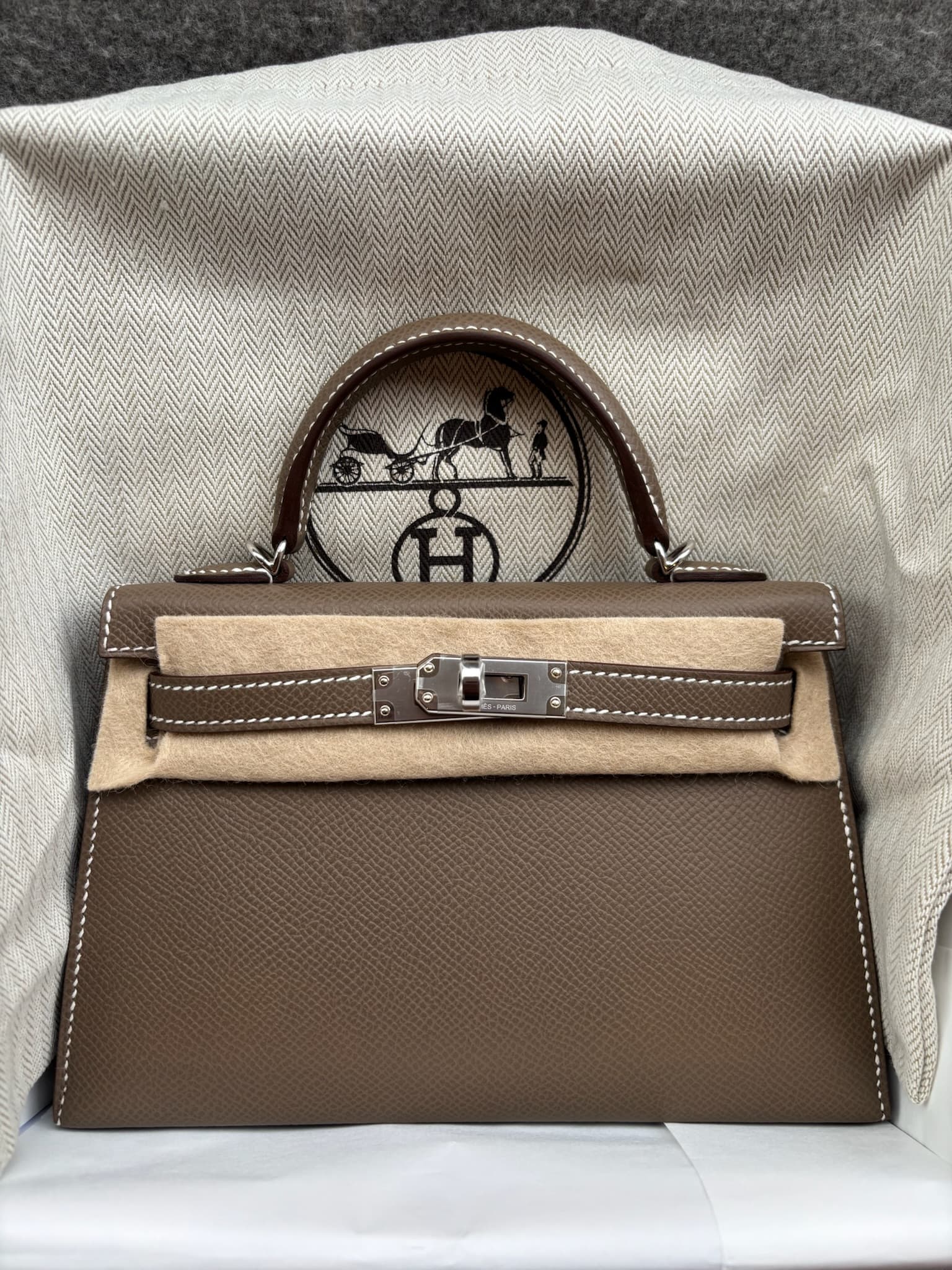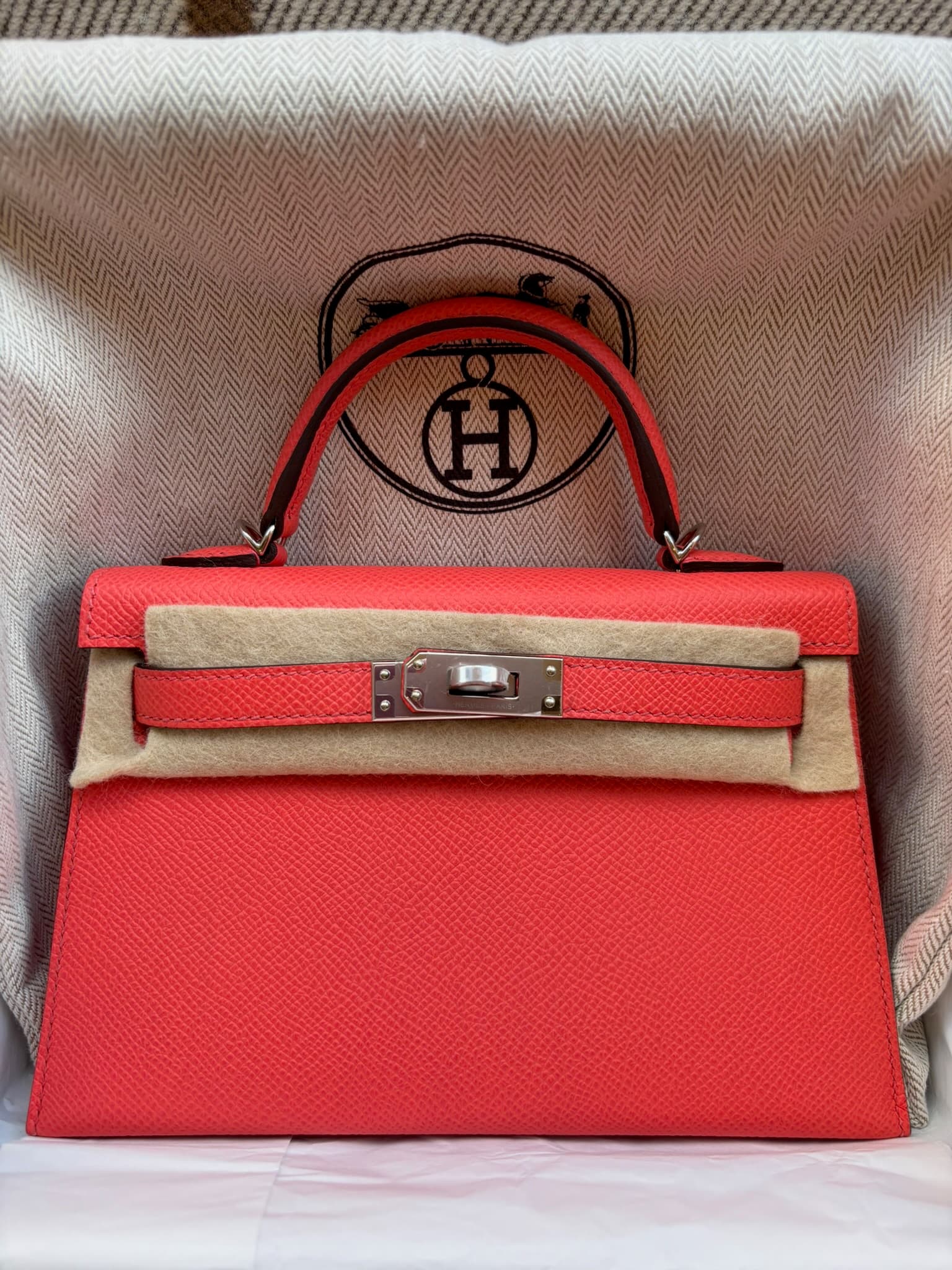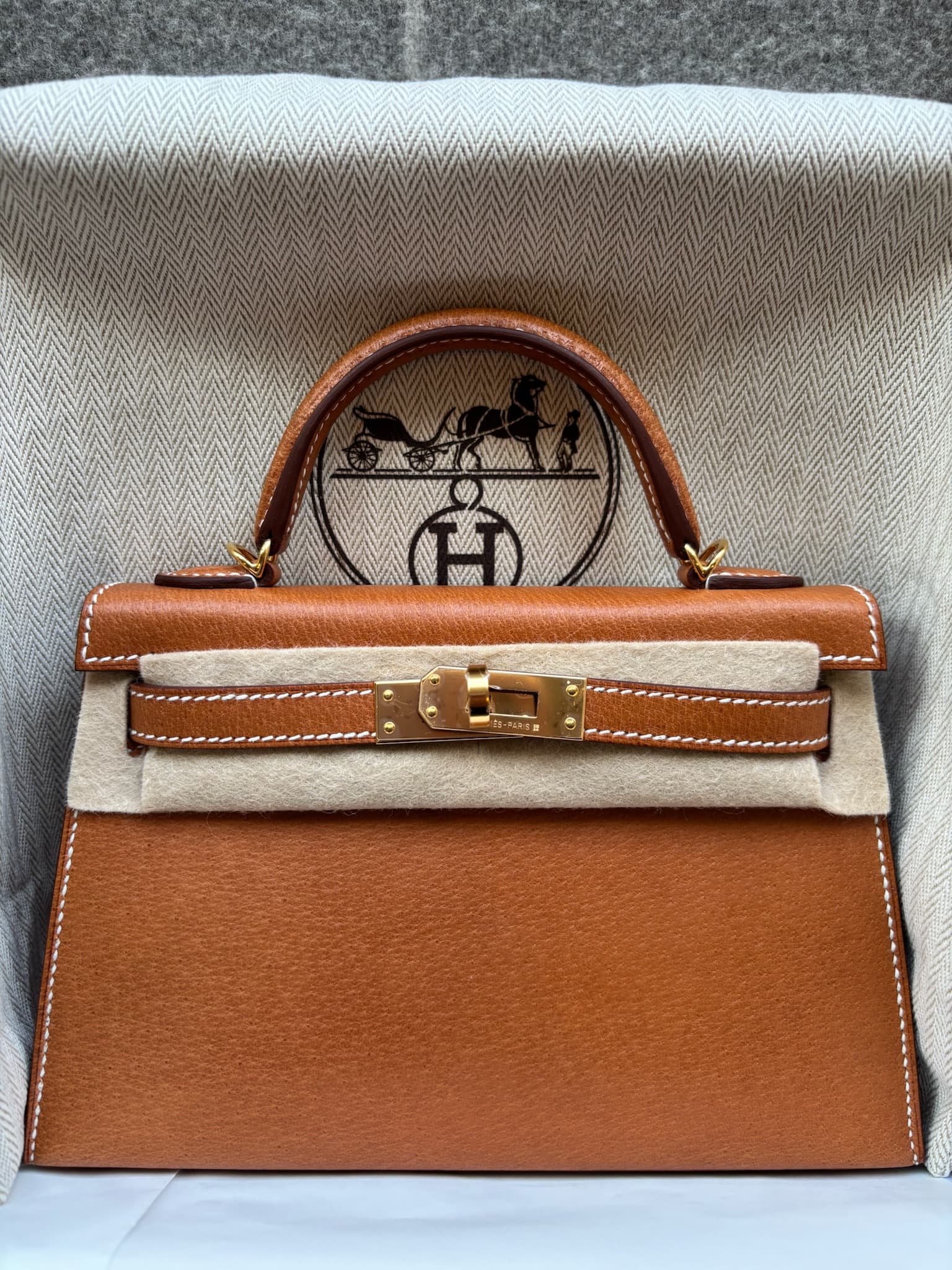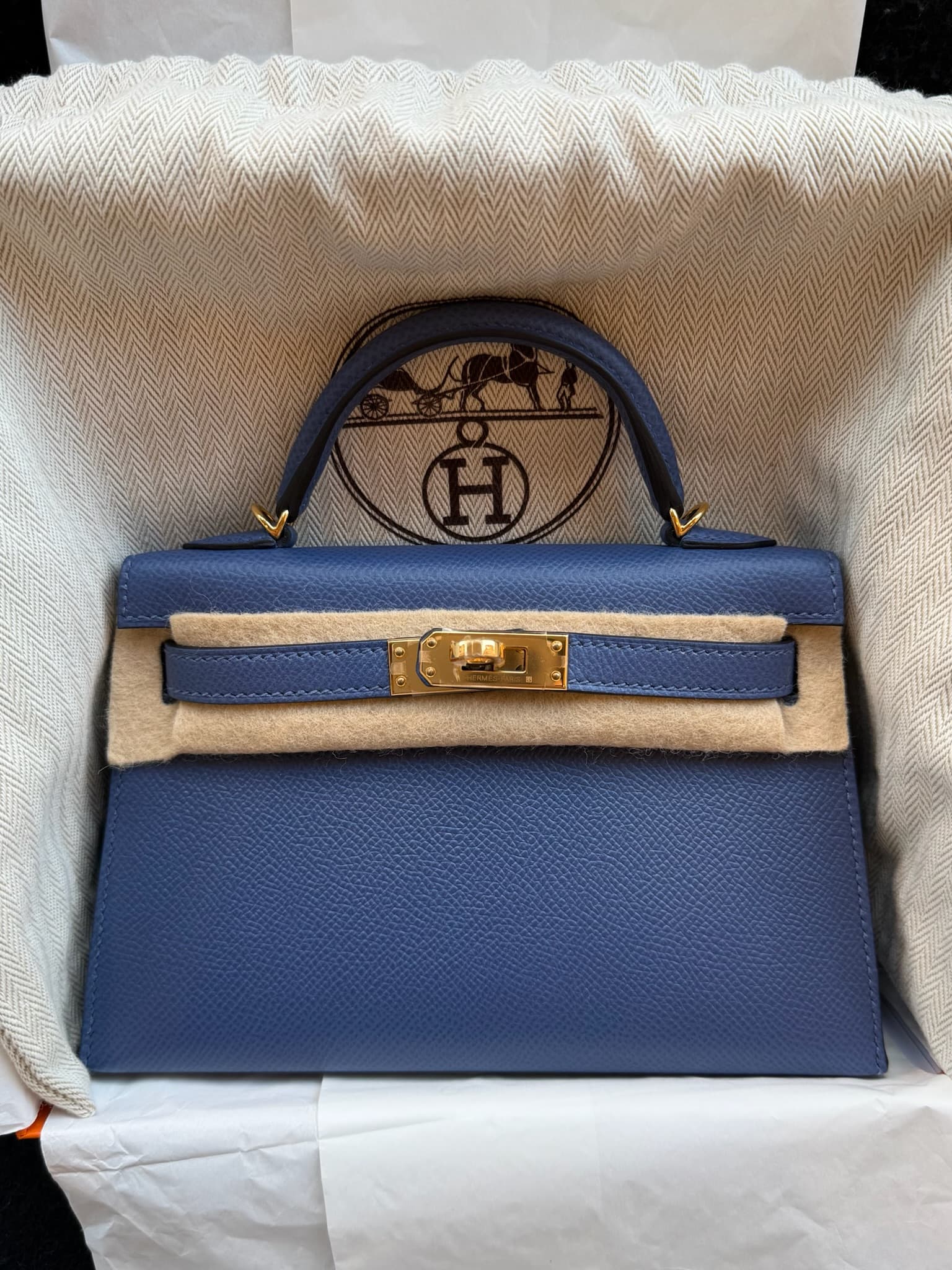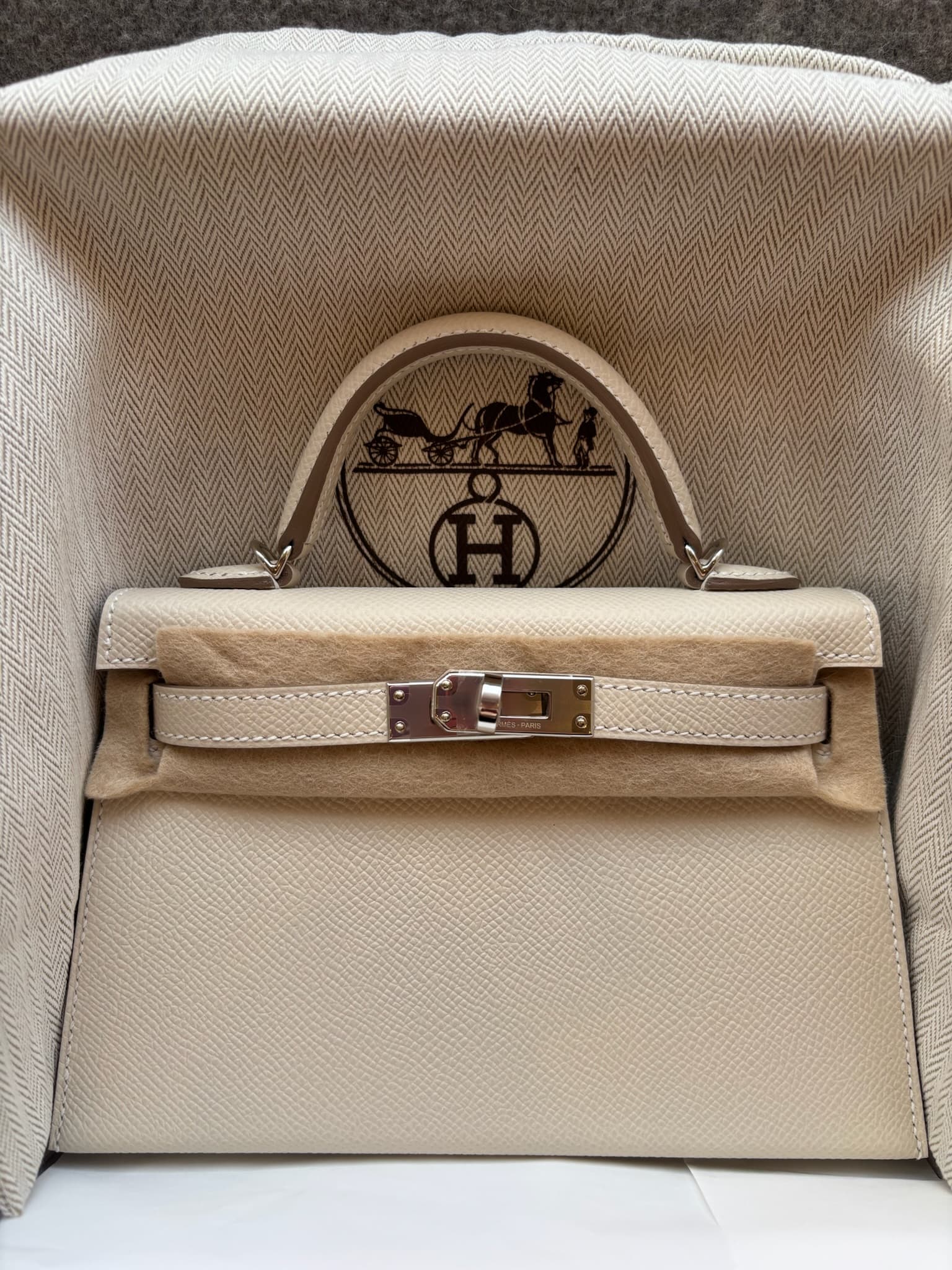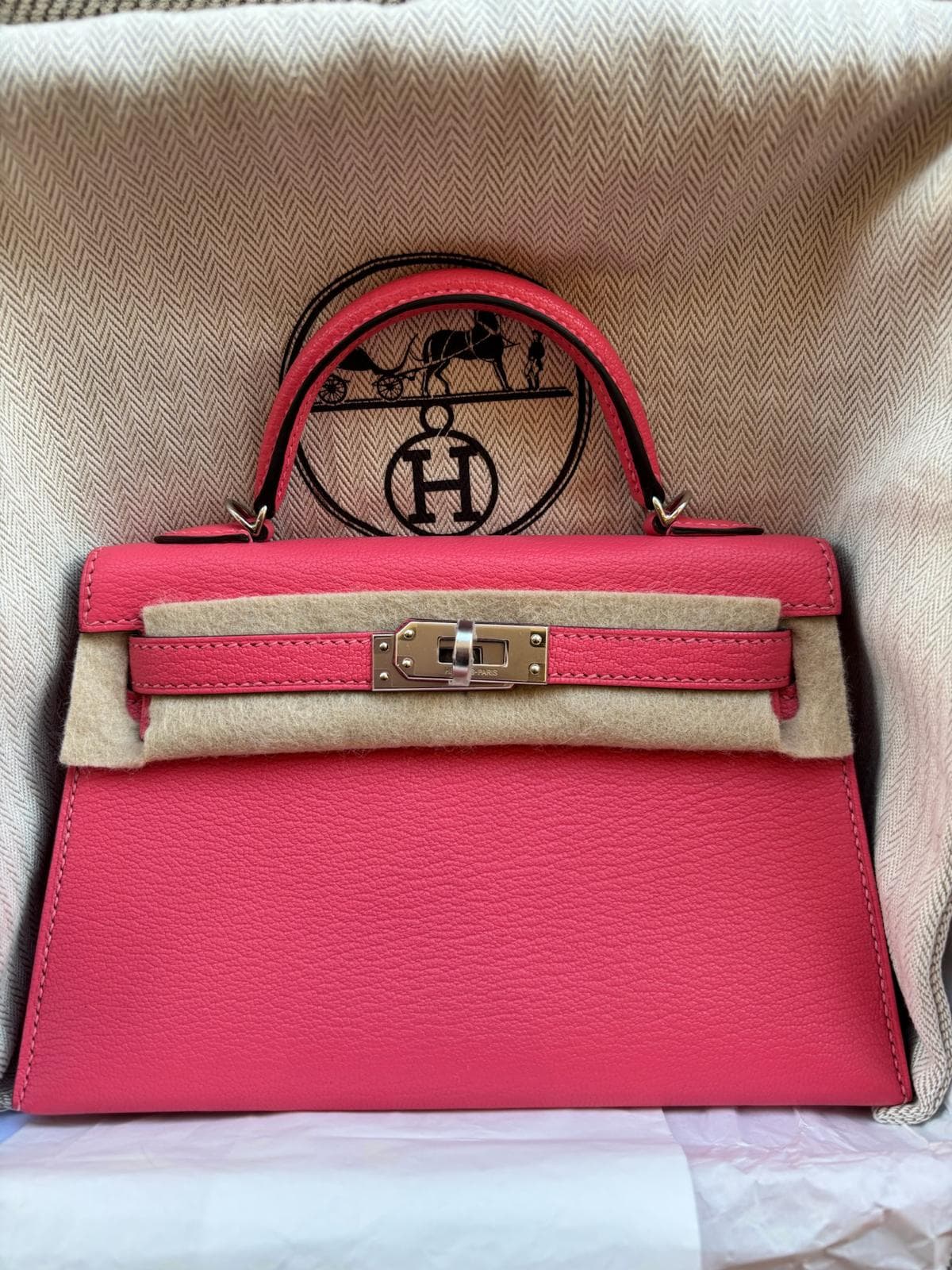
Ready to buy? See where to buy a Mini Kelly in London — over thirty pieces in our live stock, priced openly. The Hermès Mini Kelly is the hardest allocation in Paris this year — and the London secondary market is where most buyers actually get one. This guide explains what changed in 2026, what the bag really costs today, and how to buy one without the waitlist.
Every piece in our Mini Kelly collection is in stock in London and shown by appointment in Chelsea Harbour. For sizes, colours and resale values, start with our complete Mini Kelly guide.
### Why the Mini Kelly Has Eclipsed the Birkin 25 in 2026
For two decades, the Birkin 25 was the bag you whispered about. Now it is the Mini Kelly II 20 — a 20-centimetre handbag that retails for around $11,400 at the boutique and changes hands on the secondary market for $25,000 to $40,000 depending on leather and hardware. In Hong Kong and Singapore, a pristine Mini Kelly II 20 in Epsom Etoupe with palladium hardware is now harder to walk out of a boutique with than a Birkin 30 in Black Togo. That sentence would have read as nonsense in 2018. In 2026, it is the lived reality of every personal shopper we speak with.
This is the most-allocated bag in Hermès's portfolio, and demand is structural rather than seasonal. If you are reading this, you have probably already been told no by your sales associate. This guide explains why the bag is so difficult to obtain, what you should expect to pay across the boutique-to-secondary spectrum, and the three realistic routes to ownership that exist in mid-2026.
### What Exactly Is the "Mini Kelly"?
The phrase "Mini Kelly" is used loosely. In current Hermès production there are three distinct silhouettes that get called this:
| Reference | Common name | Dimensions | Notes |
|---|---|---|---|
| Kelly Pochette | "the Pochette" | 22 × 13 × 7 cm | No strap, clutch-only, single handle |
| Mini Kelly II 20 | "the Mini Kelly" | 20 × 16 × 10 cm | Detachable strap, true crossbody — this is the unicorn |
| Mini Kelly Sellier 22 | (rare) | 22 × 16 × 10 cm | Less popular, slightly larger |
When secondary-market listings say "Mini Kelly," they mean the Mini Kelly II 20 unless otherwise specified. This is the bag with the cult — small enough to feel jewellery-like, large enough to hold a phone, lipstick, key fob and a slim card holder. The single rolled top handle and detachable strap make it a true day-to-evening piece, which is rare in the Hermès portfolio at this size.
### Boutique Pricing in 2026
US retail for a Mini Kelly II 20 in Epsom now sits at approximately $11,400 — up roughly 8.6% from the 2025 price of $10,500. European retail is €8,000 in Paris, and UK boutiques are pricing in the £7,500-£8,200 band, though the sterling number is not officially published and individual stores have small variations.
Pricing scales upward sharply for exotic leathers and rare configurations. A Mini Kelly II 20 in Niloticus crocodile with palladium hardware retails for €30,000-€36,000 from the boutique; in Alligator Mat the same bag will be €25,000-€28,000. Ostrich sits between, around €20,000-€24,000.
If you are seeing higher numbers anywhere online, you are looking at secondary-market prices. The boutique price is genuinely a third (or less) of what most owners eventually pay.
### Secondary Market Reality in 2026
This is where the bag becomes interesting — and where most buyers actually transact. The Mini Kelly II 20 secondary market in mid-2026 looks roughly like this:
| Leather | Hardware | Typical secondary range | Premium over retail |
|---|---|---|---|
| Epsom (Etoupe, Gold, Noir) | Palladium or Gold | $25,000-$33,000 | 2.2x-2.9x |
| Swift (Rose Sakura, Vert Cypress) | Palladium | $30,000-$40,000 | 2.6x-3.5x |
| Chèvre Mysore | Either | $28,000-$36,000 | 2.4x-3.1x |
| Ostrich | Either | $35,000-$48,000 | 1.5x-2.0x |
| Niloticus Crocodile | Palladium | $50,000-$70,000 | ~1.7x |
The headline number we hear most often from our private clients is $31,900 — the median 2026 listing across the most popular leather-and-colour combinations. The full range across all configurations runs from approximately $20,000 (older or scratched pieces) to $56,000 (mint Swift seasonals).
A few patterns to know:
- Swift commands a premium over Epsom in this size because the slouchier hand reads as more "luxurious-casual" in person, and because Hermès produces fewer Swift Mini Kellys per year. Resellers report Swift outperforming Epsom by 10-20% on like-for-like specifications. - Black always sells. A Black Epsom Mini Kelly with palladium hardware is the safest collector configuration. Resale liquidity is excellent and prices are stable. - Seasonal colours fluctuate. Last year's Rose Sakura traded at a $5,000 premium; this year it sits at parity with Etoupe. Buy seasonals because you love them, not as an investment hedge.
### Allocation Politics, by City
Boutique-direct purchase of a Mini Kelly requires a strong client history. "Strong" means different things in different cities:
Paris (Faubourg Saint-Honoré, George V, Sèvres): Realistic Mini Kelly allocation for an established client begins around €30,000-€40,000 of pre-spend on RTW, jewellery, homeware and accessories, accrued over twelve to twenty-four months. A first-time tourist client should not expect a Mini Kelly offer; this is the most disciplined boutique network in the maison.
London (New Bond Street, Sloane Street, Royal Exchange): UK boutiques operate similarly to Paris but with marginally lower pre-spend thresholds — call it £20,000-£30,000 of consistent client history over a year. The Mini Kelly is offered roughly once every nine to fourteen months to established clients.
Hong Kong / Singapore: Demand is structurally higher here than supply. Boutique allocation requires £40,000-plus in client history, often with a one-to-two-year lead time. Many serious collectors source their Mini Kelly via Europe specifically because Asia is too tight.
New York / Beverly Hills: US boutiques are slightly more flexible, particularly Beverly Hills, where a tourist with strong RTW spend can sometimes secure a Mini Kelly offer in six to nine months. Bal Harbour is the most generous boutique in the US network at present.
Middle East (Dubai Mall, Riyadh): Allocation is brisk for ultra-high-net-worth clients with private VIP relationships. For everyone else, supply is very thin.
This is why the secondary market exists, and why our concierge desk at JULL spends a meaningful share of each week sourcing Mini Kellys for UK clients who want to skip the line.
### Sellier vs Retourné on the Mini Kelly
A frequent question: does the Mini Kelly come in Sellier construction? The Mini Kelly II 20 is primarily produced in Retourné construction (stitched inside-out, softer profile). The Mini Kelly Sellier 22 is the rare structured variant, with the seams on the outside for that crisp architectural silhouette. The Sellier 22 is harder to find on both boutique and secondary, and it carries a 10-15% premium when it does surface.
For everyday wear most collectors prefer the Retourné — it is more forgiving of light scuffs and the slouchier shape is friendlier to a phone and key fob. The Sellier 22 is the choice for evening and editorial wear.
### The Three Realistic Routes to Ownership
If you do not have a fifteen-year client relationship with Hermès Paris, your three serious options in 2026 are:
1. Patient boutique cultivation (12-24 months). Pick one boutique, work with one sales associate, build genuine client history through RTW, jewellery and homeware, and ask for the bag only when it makes sense. Honest, slow, eventually works. Expect to spend £20,000-£40,000 of pre-spend before the first quiet bag offer.
2. Authenticated secondary purchase from a reputable specialist. Pay the premium, take the bag home this month. The secondary market is mature, transparent and increasingly well-regulated. A specialist like JULL — see our in-stock Hermès Kelly bags here — will hand-inspect every piece, verify the blind stamp, leather, hardware and construction, and provide the relevant authentication documentation. Expect to pay $25,000-$40,000 depending on configuration.
3. Auction. Christie's, Sotheby's, Phillips, and Bonhams all run regular Hermès auctions. Auction pricing is competitive with private specialists in most months, though buyer's premiums (typically 25-27%) push the all-in cost up. Auction wins on Mini Kellys typically settle within the $26,000-$38,000 range for popular leathers. The drawback is the wait — you bid, you win or lose, and the next opportunity is six to twelve weeks out.
### What to Avoid
The most common mistakes we see Mini Kelly buyers make:
- Buying without inspecting the leather under raking light. Swift in particular shows oxidation and rub marks on the corners that are invisible in seller photos. Always request inspection light photos before purchase. - Paying for an "investment grade" exotic without auction history. Niloticus and Alligator Mini Kellys are beautiful but their secondary market is thinner than leather equivalents, which means lower liquidity if you ever need to resell. - Trusting unverified Instagram resellers. The fake-bag problem on Mini Kellys is severe in 2026 because the bag is small enough to be replicated convincingly. Work through our 14-point authentication guide — or buy from a hand-inspecting specialist with insurance and provenance. - Buying in the wrong leather for your climate. Chèvre Mysore is exquisite in dry climates but vulnerable in humid ones; Swift bruises in tropical air; Epsom is the all-rounder for everyday wear in any city.
### A Word on Pricing Trajectory
The Mini Kelly secondary market has compounded at roughly 7-9% per year since 2020 in the popular Epsom and Swift configurations. This is in line with the broader Mini Kelly category and slightly ahead of Birkin 25 appreciation in the same window. The bag is not a guaranteed investment — no luxury good is — but the structural demand-supply imbalance shows no signs of softening in 2026. If you are buying the bag to wear, you should not lose money on it should you ever decide to part with it, provided you maintain it well.
For collectors specifically: Black Epsom with palladium remains the safest long-term configuration. Etoupe is the second-safest. Seasonal colours can outperform but can also stagnate; allocate to seasonals with your heart, not your portfolio.
### How JULL Sources Mini Kellys for Our Clients
We source Mini Kellys directly from established collectors and through our private dealer network in London, Paris and Geneva. Every bag is hand-inspected in our Chelsea Harbour workroom by our authentication team before it reaches stock, and every piece is photographed under raking light for full transparency. We do not accept consignment from sellers we have not vetted, which is why our inventory is smaller than aggregators but considerably safer.
If you are looking for a specific Mini Kelly configuration — particular leather, hardware, year of production or condition grade — our concierge team can source on commission. The typical sourcing window is two to six weeks for popular Epsom and Swift specifications. Start a private sourcing brief here.
### FAQ
What is the difference between the Mini Kelly II 20 and the Kelly Pochette? The Pochette is a clutch — no strap, single rolled handle, 22 × 13 × 7 cm. The Mini Kelly II 20 is a true crossbody, with a detachable strap and slightly different proportions (20 × 16 × 10 cm). The Pochette is roughly 60% the price of the Mini Kelly on both boutique and secondary.
How much does a Mini Kelly retail for in 2026? Approximately $11,400 in the US, €8,000 in Europe, and £7,500-£8,200 in the UK for the standard Epsom configuration. Exotics retail at a substantial premium.
Is the Mini Kelly a good investment? The secondary market has compounded at 7-9% per year since 2020 in popular leathers. It is not a guaranteed investment but it has been a more reliable store of value than most luxury bags. Buy because you love it; treat appreciation as a bonus.
How long is the wait for a Mini Kelly at the boutique? For an established client with strong purchase history, the realistic wait is twelve to twenty-four months. For a new client without history, expect to be told no — building a client relationship to the point where a Mini Kelly is offered typically takes one to two years of consistent spend across the maison's product range.
Can I buy a Mini Kelly without entering a boutique? Yes. Authenticated specialist resellers like JULL and reputable auction houses are the two principal routes. Secondary pricing is two to three times retail for popular leathers, which is the cost of skipping the wait.
Which Mini Kelly leather holds its value best? Black or Etoupe Epsom with palladium hardware is the safest. Swift in seasonal colours can outperform short-term but is less liquid long-term. Exotics are beautiful but harder to resell.
Is the Mini Kelly waterproof? No. None of the leathers used in production are waterproof. Epsom is the most weather-tolerant; Swift and Chèvre Mysore are the most vulnerable to water staining. Always carry a Mini Kelly with weather in mind.
### Looking for a Specific Mini Kelly?
We currently hold a curated selection of authenticated Mini Kelly and Kelly bags at our Chelsea Harbour showroom. Browse our Kelly inventory, or start a private sourcing brief for a specific configuration. Every piece is hand-inspected, photographed under raking light, and accompanied by full provenance documentation.