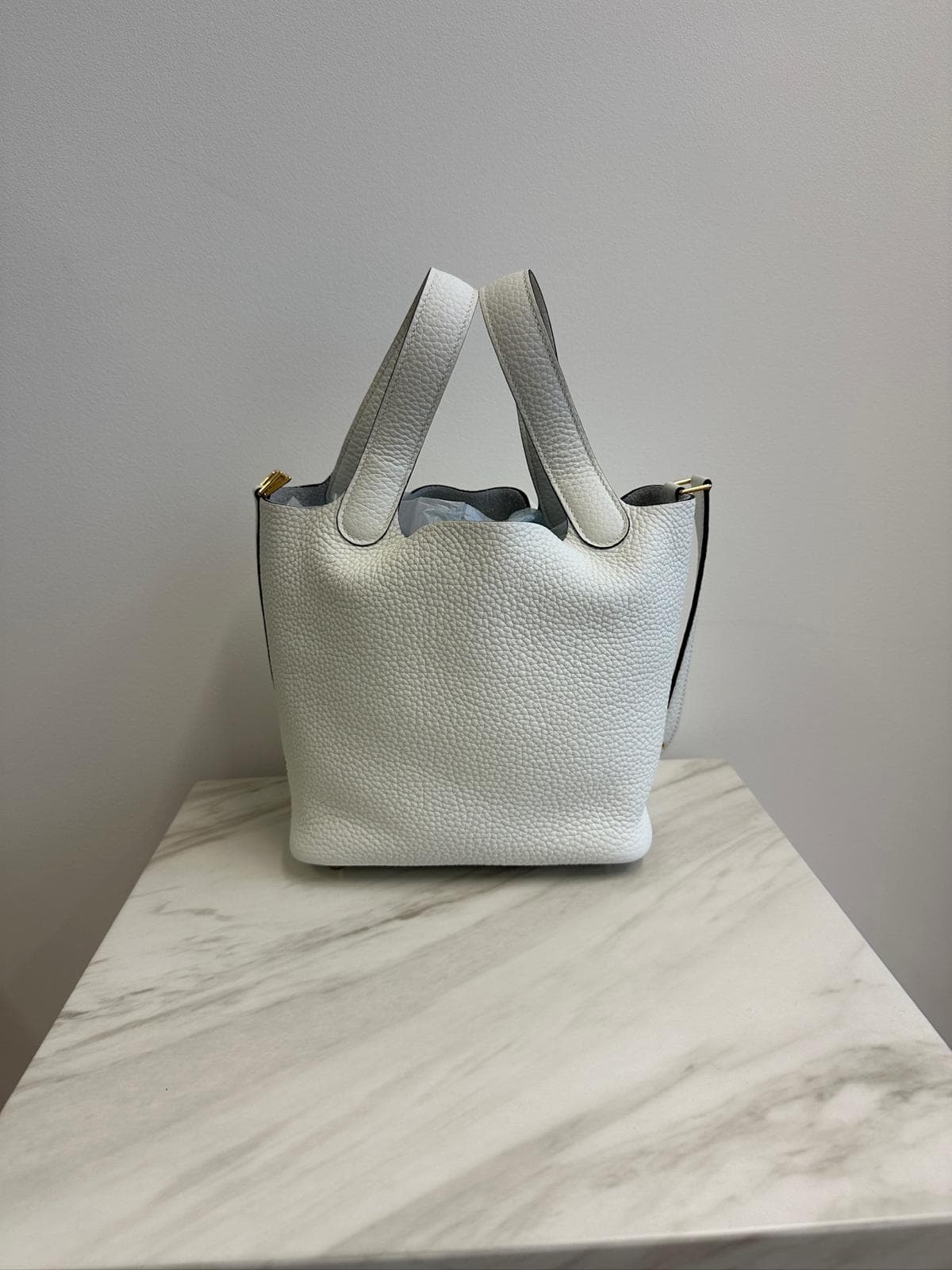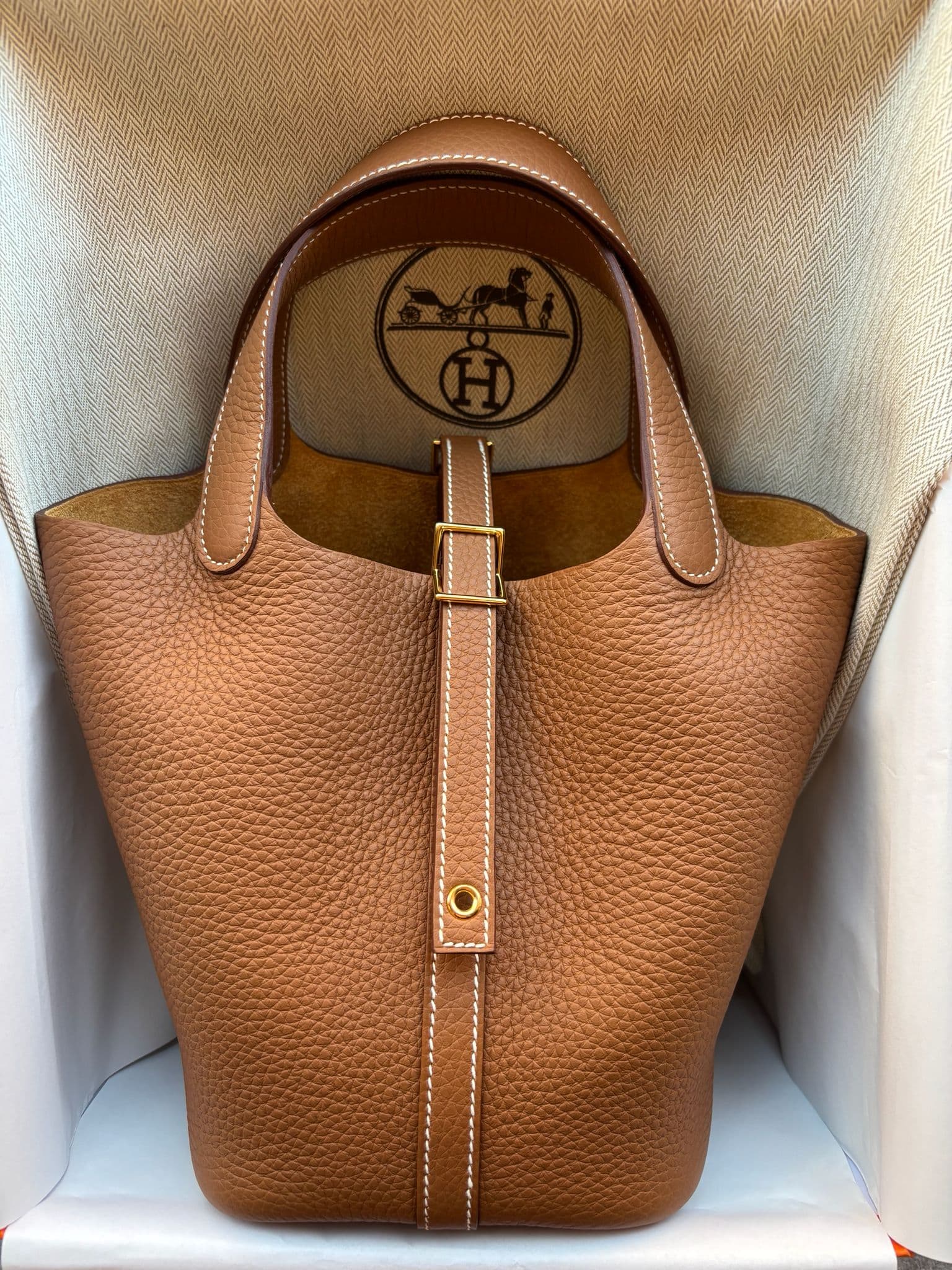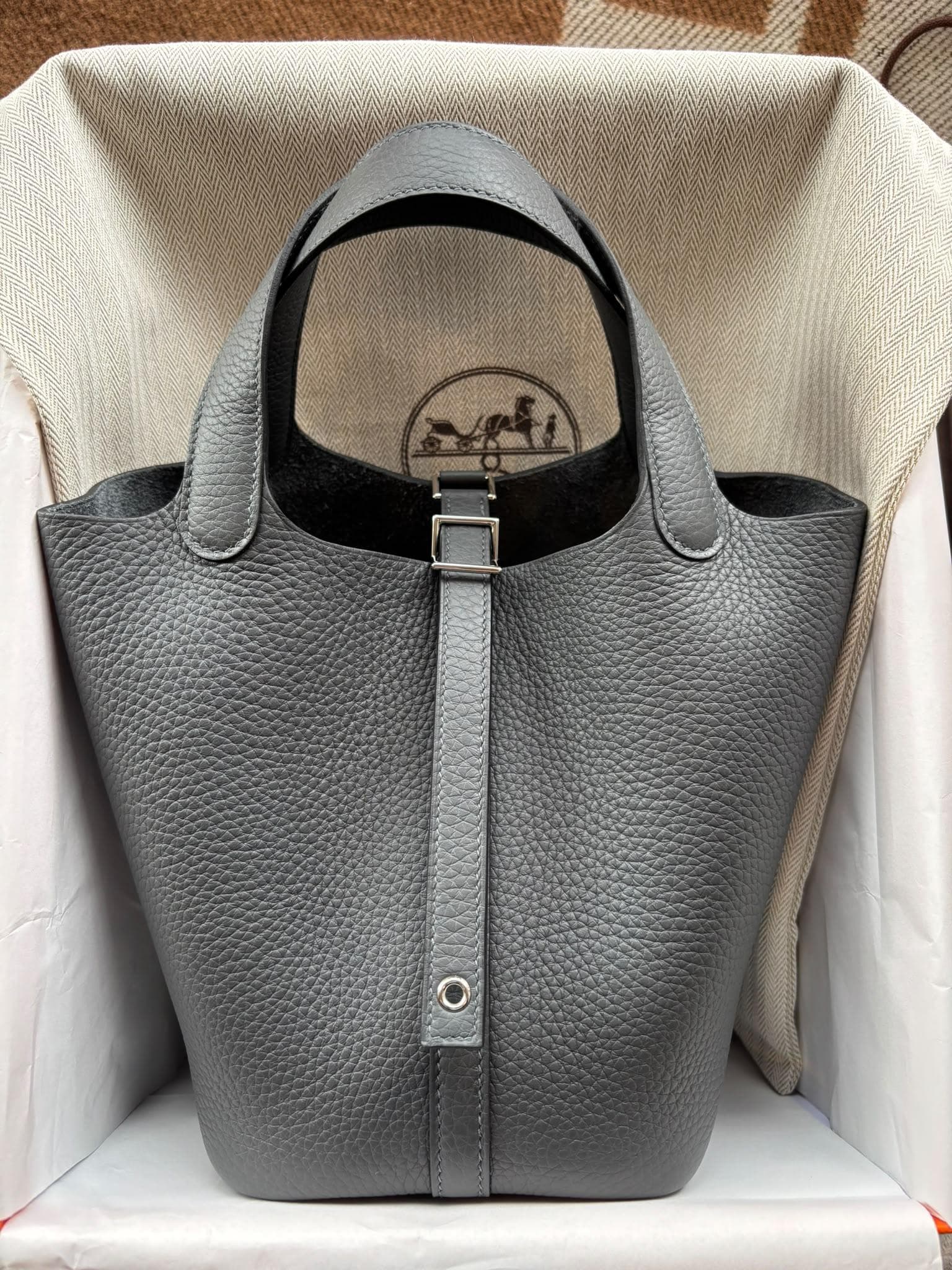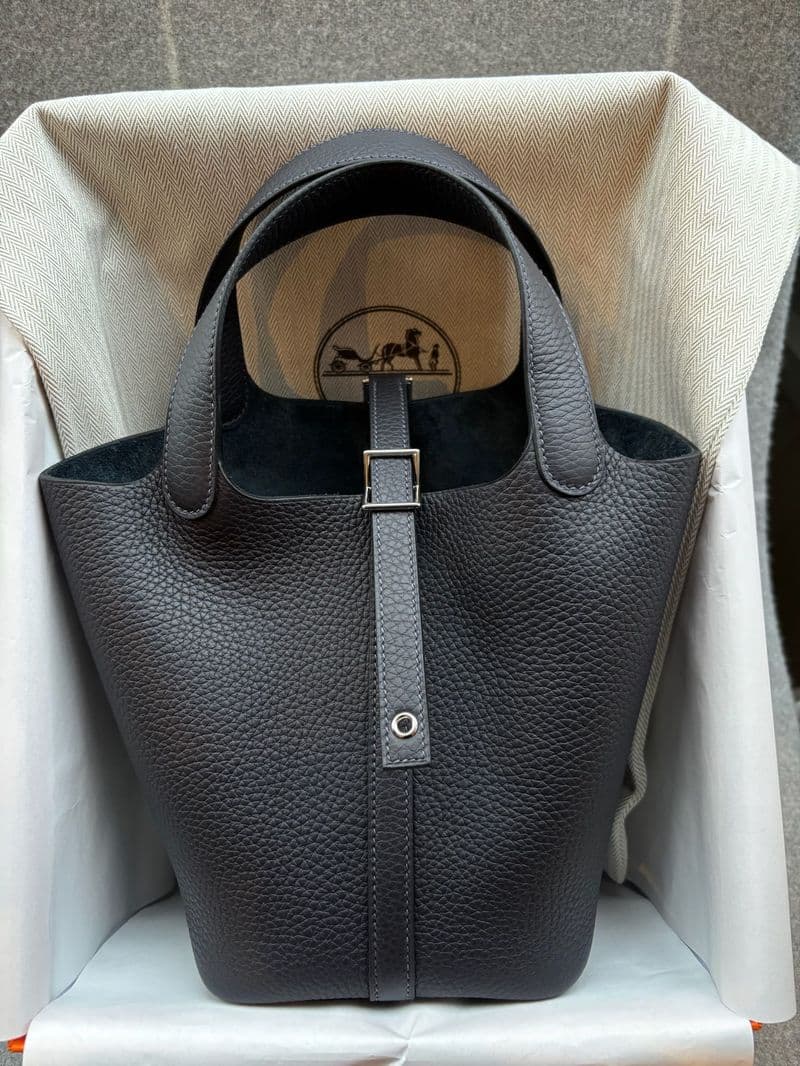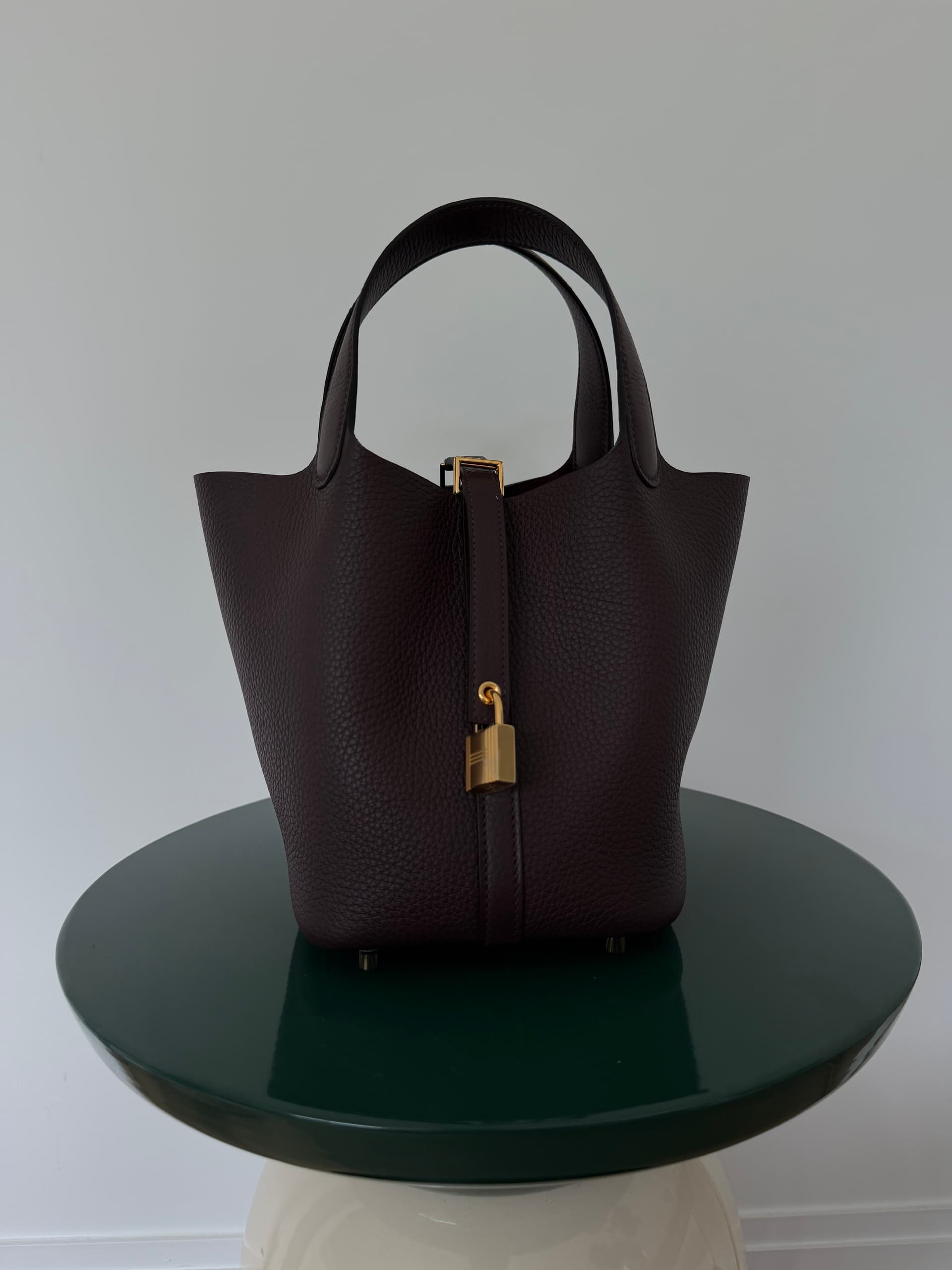
What a Picotin, and the everyday bags beside it, cost at JULL today
Counted from our own London stock on 27 October 2026: 18 pieces available, £2,850 to £29,000. These are asking prices at JULL, not market estimates, and the table is rebuilt from the shelf every day, so a row disappears when the last one sells.
| Model | In stock today | Price at JULL |
|---|---|---|
| Hermès Picotin 18 | 7 | £3,900 to £4,750 |
| Hermès Mini Bolide | 3 | £7,000 to £29,000 |
| Hermès Evelyne | 3 | £2,850 to £4,500 |
| Hermès Picotin 14 | 3 | £11,000 to £12,500 |
| Hermès Mini Lindy | 2 | £9,900 |
Every piece above is in London and can be seen at our Chelsea Harbour showroom. See the current stock or ask us to source a specific one. Every model, with its lowest, middle and highest price, is in the UK Hermès Price Index.
Every collector remembers their first Hermès. For a growing majority, it is not a Birkin or a Kelly — it is a soft, open-topped bucket bag named after a feed sack. The Picotin Lock is the house's most accessible icon: genuinely buyable, genuinely usable, and quietly one of the strongest value stories in the range. This is the complete 2026 guide — sizes with real measurements, current UK prices at retail and on the secondary market, the leathers, the colours that hold value, and the honest case for and against.
What the Picotin Actually Is
Introduced in 2002 and named after the picotin — the measure of oats fed to a horse — the Picotin is Hermès at its most equestrian-literal: a feed-bag silhouette in leather, open-topped, with two handles and, since the "Lock" update, a strap-and-touret closure that takes a padlock. No zips, no flap, no logo. It slouches slightly, swallows more than its size suggests, and reads as unmistakably Hermès to anyone who knows — which is precisely its charm. Where the Birkin announces, the Picotin implies.
Two facts define its market position. It is one of the few Hermès bags a boutique will actually sell you without a purchase history — allocation politics barely touch it. And it is the house's price floor for a proper leather bag, which makes it both the classic first Hermès and the classic "one more colour" bag for collectors who own everything else.
Sizes: 14 to 22, Measured Honestly
| Size | Dimensions (cm) | Carries | Best for |
|---|---|---|---|
| Picotin Micro 14 | 14 × 13 × 10 | Phone, cards, keys | Trend piece, exotics showcase |
| Picotin 18 (PM) | 18 × 19 × 13 | Daily essentials + sunglasses | The default — most liquid size |
| Picotin 22 (MM) | 22 × 23 × 16 | Everything, small laptop at a push | Work and errands |
| Picotin 26 (GM) | 26 × 27 × 19 | Genuine tote duty | Rarely produced, niche |
The 18 is the bag most people mean when they say Picotin: big enough for real life, small enough to stay elegant, and the size the resale market rewards most consistently. The 22 has been gaining as the everyday-tote alternative. The Micro 14 — especially in ostrich — has become a collector's object in its own right, trading well above its size.
UK Prices 2026
| Size / spec | UK boutique (approx.) | Secondary, excellent condition |
|---|---|---|
| Picotin 18, Clémence | ~£3,300–£3,600 | £4,000–£4,600 |
| Picotin 22, Clémence | ~£3,700–£4,000 | £4,200–£4,900 |
| Micro 14, classic leathers | ~£3,000 | £3,800–£4,500 |
| Micro 14 / 18 in ostrich | by allocation | £10,000–£13,000 |
Note the shape of that table: the Picotin trades above retail pre-owned — modestly, but consistently. Few bags under £5,000 from any house can say that. The premium reflects the same arithmetic as its bigger siblings — demand comfortably ahead of boutique supply — just at a gentler temperature. Our price guide tracks the whole range; the Picotin has been among its most stable lines for years.
Leathers and Colours
The Picotin lives in Taurillon Clémence — the soft, matte, pebbled leather that gives the bag its relaxed slouch and shrugs off scratches; it is the correct choice for a bag designed to be used daily (Clémence vs Togo vs Epsom explained here). Swift appears in brighter colours, ostrich elevates the Micro into jewellery territory, and the occasional Lizard or exotic-handle edition trades as a collectible.
Colour logic follows the house rules — Gold with palladium hardware is arguably the definitive Picotin spec, Étoupe and Black are the liquidity kings, and the bag's casual character makes it one of the few Hermès where a bold colour (Rouge H, Vert Criquet, Bleu Royal) costs you nothing at resale. The full hierarchy is in our resale colour index.
The Honest Case For — and Against
For: the lowest genuine entry into Hermès leather; buyable at boutique without a campaign; daily-proof; holds value above retail; the strap-and-lock detail gives it more design identity than any competitor's bucket bag at triple the price. As a first Hermès or a beater-bag for someone who owns quota pieces, it is close to unarguable — which is why we called it the best way to start a collection.
Against: the open top is real — no security for commuting crammed trains; the slouch divides opinion; and it will never appreciate like a Birkin or Kelly — this is a value-holder, not an investment vehicle. If your first Hermès needs to double as an asset, the arithmetic in our investment analysis points you elsewhere.
Buying in 2026: The Checklist
Corners and base first — Clémence is forgiving but soft; scuffed base corners are the Picotin's honest mileage counter. Check the touret and lock — closure hardware should be crisp, the padlock keyed and present; missing locks knock real money off. Smell and interior — the unlined interior shows wear honestly; that's a feature at purchase time. Authenticate the stamp — Picotins are heavily faked precisely because they're the "affordable" Hermès; the blind stamp and stitch geometry are the tells, and our authentication guide shows both up close. Our current Picotins — 18s, 22s and the ostrich Micros when they land — are in the bags gallery, authenticated and viewable in Chelsea Harbour.
Picotin vs Evelyne vs Garden Party: The Entry-Level Decision
The Picotin's real rivals are its own stablemates, and the choice maps cleanly onto how you live. The Evelyne wins for hands-free commuting — crossbody by design, perforated H, lighter money — but carries its logo louder than anything else Hermès makes. The Garden Party wins for sheer capacity and the lowest entry price, at the cost of canvas panels and a tote-crowd silhouette. The Picotin wins on leather purity — all-Clémence, no canvas, no visible branding — and on resale, where it is the only one of the three that consistently clears retail. Our rule of thumb for first-bag consultations: commuters take the Evelyne, parents take the Garden Party, and everyone who hesitates takes the Picotin and never mentions it again.
One more comparison worth naming: the Picotin against the wider luxury market. At £4,000–£4,600 pre-owned it sits against Loewe's large Puzzles and Bottega's Andiamos — bags that lose 30–50% the moment they leave the till. The Picotin's flat-to-positive curve is not glamorous, but over five years of ownership it is the difference between a bag that cost you nothing and a bag that cost you two grand. That arithmetic, more than any styling argument, is why it remains our most-recommended first Hermès.
Frequently Asked Questions
How much is an Hermès Picotin in 2026? UK boutique pricing runs roughly £3,300–£4,000 for the 18 and 22 in Clémence. Pre-owned examples in excellent condition trade at £4,000–£4,900 — a modest, stable premium over retail. Ostrich Micros run £10,000+.
Is the Picotin hard to get at Hermès? Far easier than any quota bag — Picotins do reach the open floor, and polite persistence at a boutique usually works within weeks rather than years. Specific colour-size-leather combinations remain a lottery, which is where the secondary market earns its premium.
Which Picotin size is best? The 18 for most people and the strongest resale; the 22 if it will be your daily work bag; the Micro 14 as a collectible or an exotics showcase. The GM 26 exists but is rarely the right answer.
Does the Picotin hold its value? Yes — consistently at or slightly above retail for classic specs in good condition, which is exceptional for a bag at this price point. It holds value rather than grows it: buy it to use, not to invest.
Is the Picotin a good first Hermès bag? It is the classic answer, and for good reason: real Hermès leather and craft, a usable everyday design, boutique-buyable, and financially forgiving. If the open top suits your life, there is no better starting point in the house.
---
JULL is a specialist Hermès personal shopping service in Chelsea Harbour, London. We source new, unworn and pre-owned Picotin, Birkin, Kelly and other Hermès pieces through a private network — every bag authenticated and available to view at our Chelsea Harbour showroom. Browse available bags or get in touch.