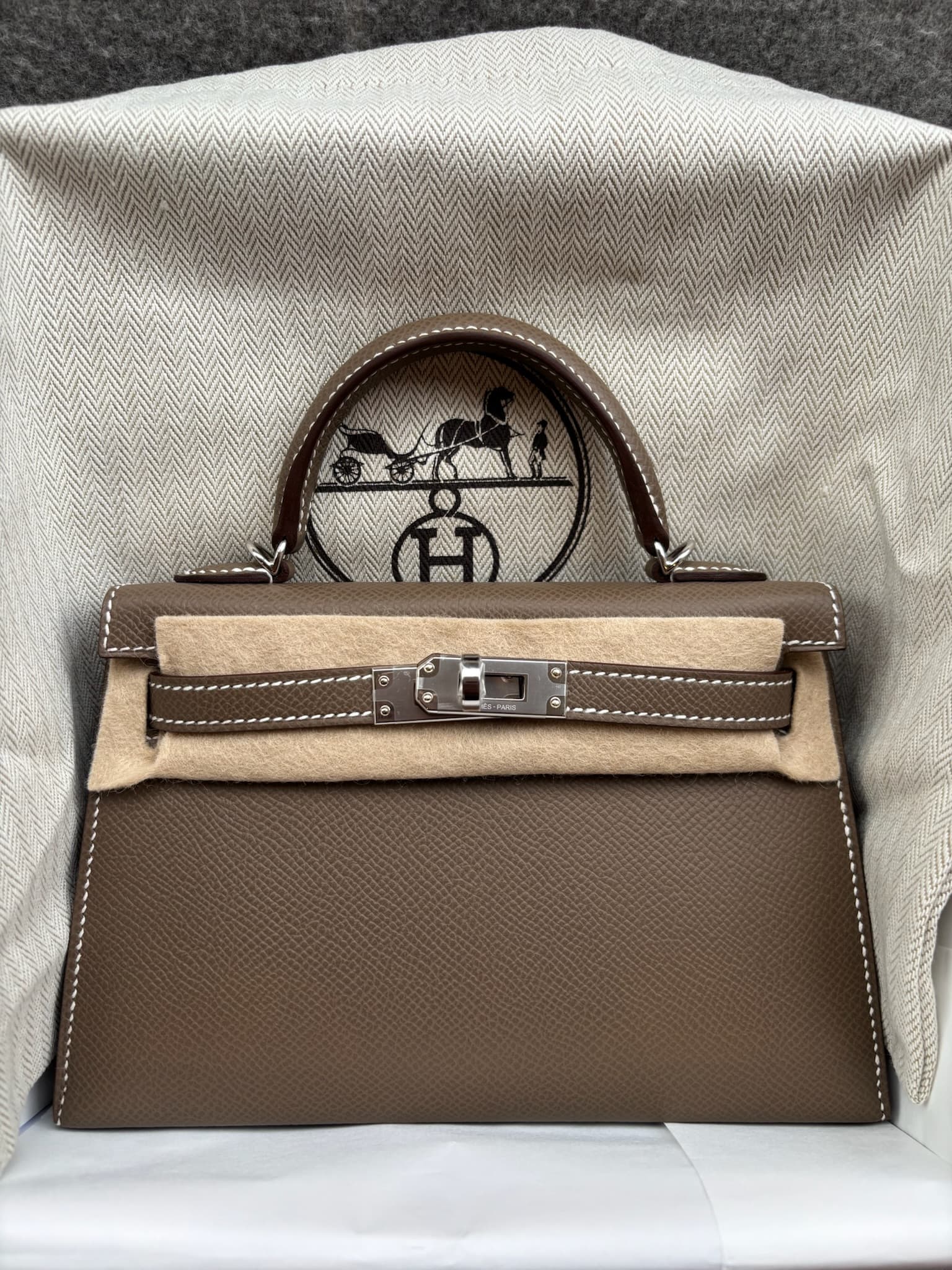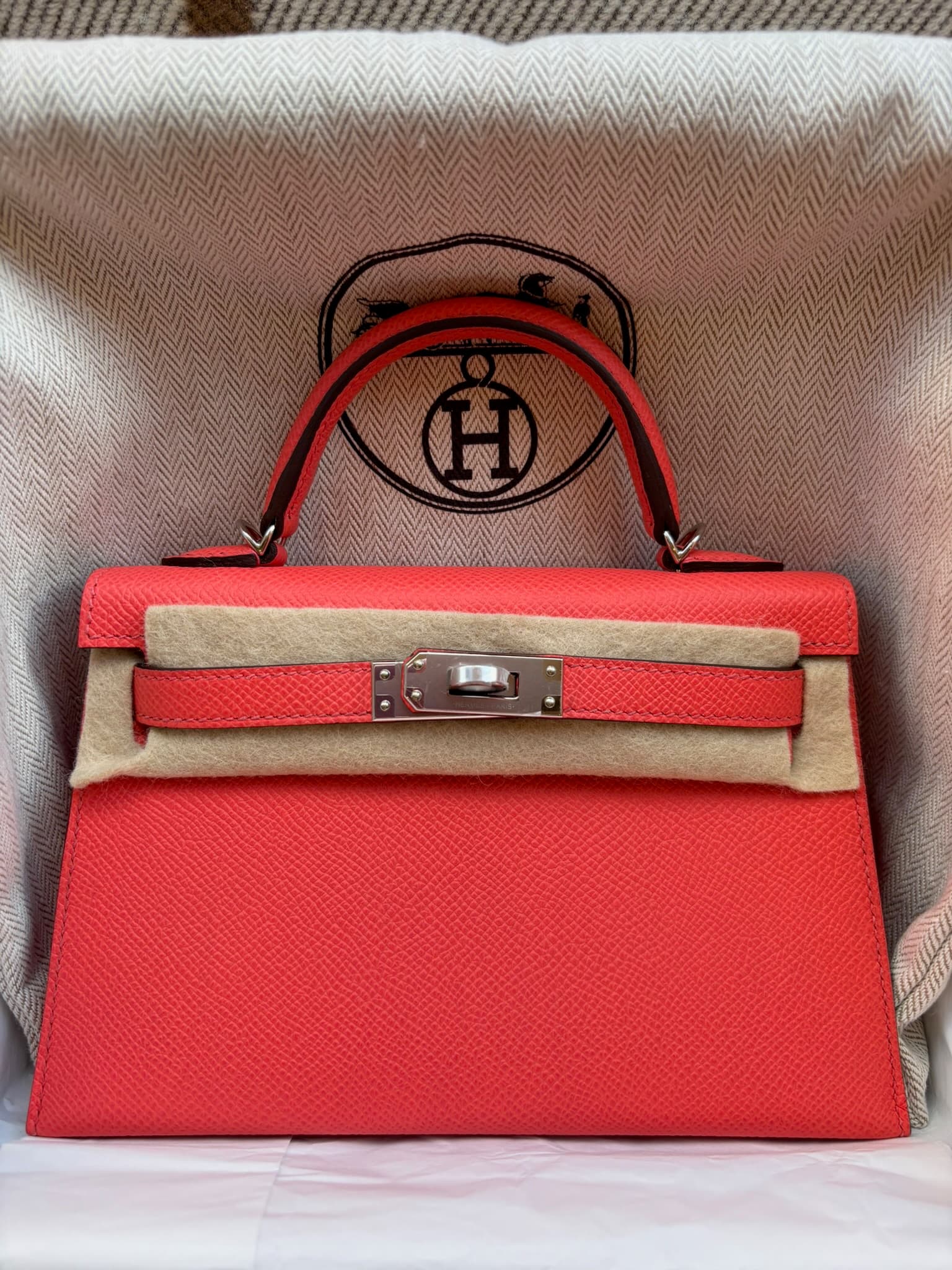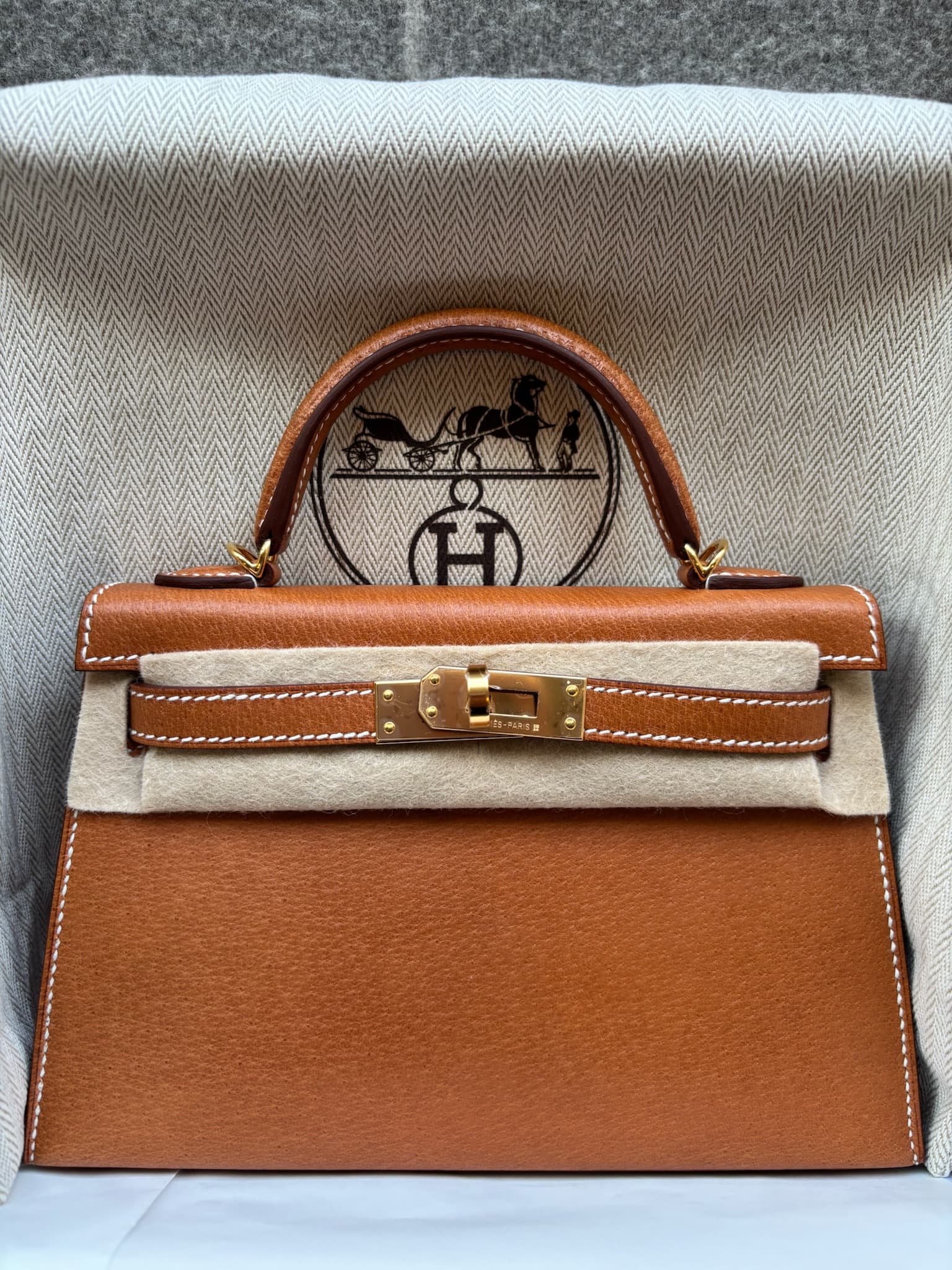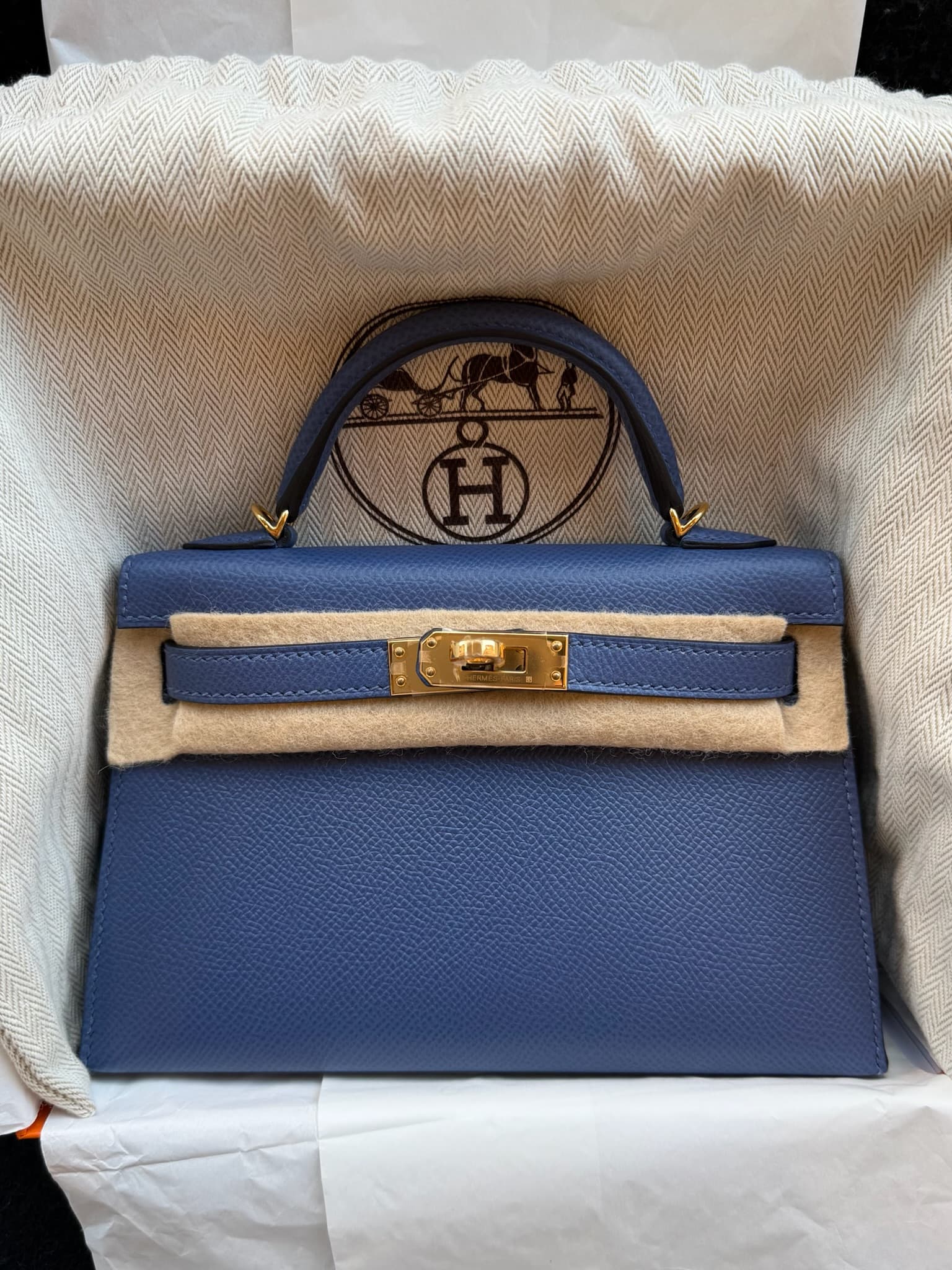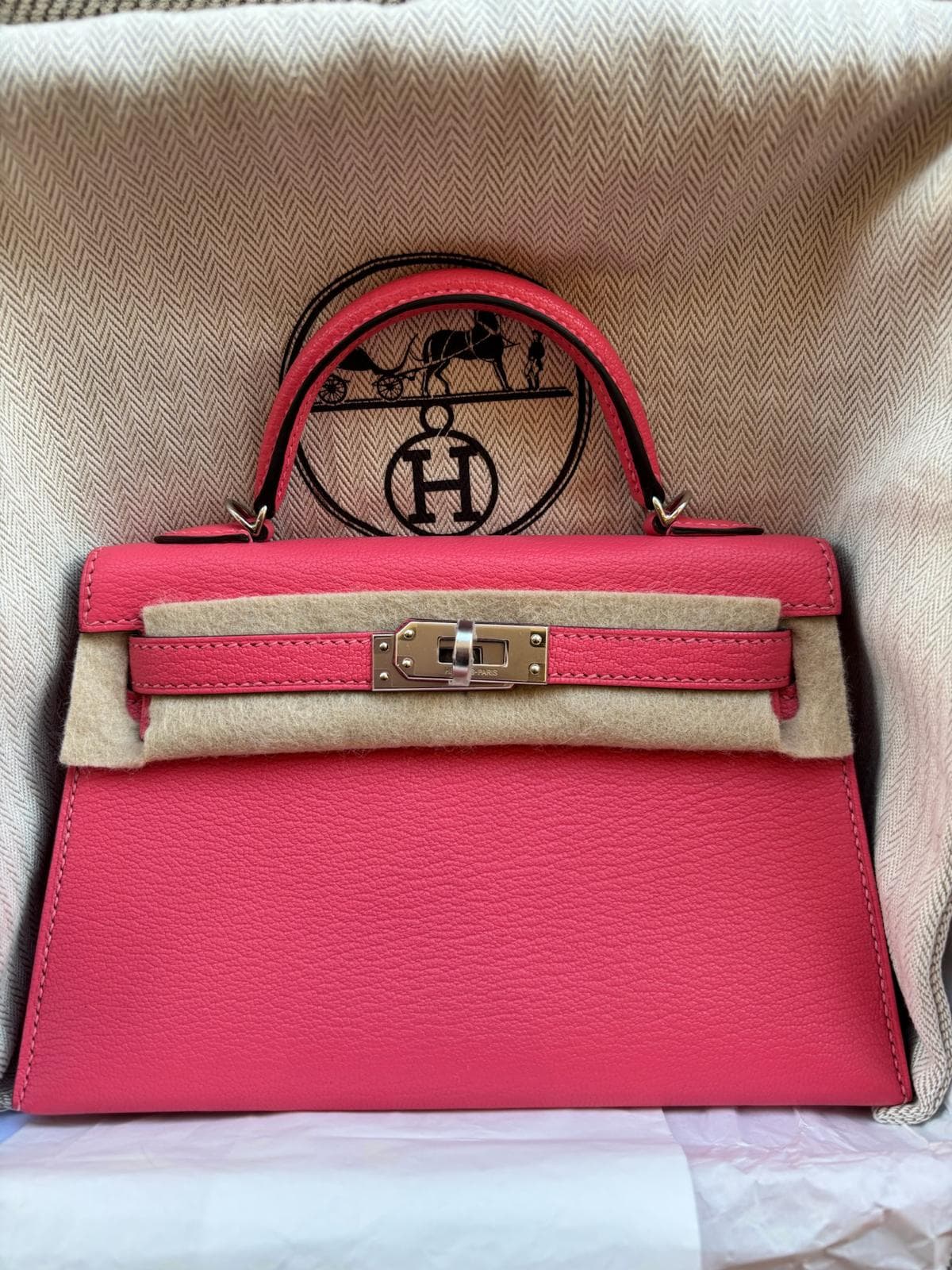
Two bags share the name Kelly, the turnlock and the strap — and behave like different animals. The Sellier stands at attention; the Retourne slouches beautifully. The difference is a single decision made at the workbench, and it changes how the bag looks, how it lives, what it costs and who it suits. Here is the complete comparison, from a London house that stocks both and sells both weekly.
What the words actually mean
Sellier is French for saddler, and the construction is exactly that: the panels are stitched together from the outside, edges left standing, then painted and polished. The seams sit proud, the corners are knife-sharp, and the bag holds its architecture empty or full. Retourne means turned — the bag is stitched inside out and then reversed, the way most soft bags are made, tucking the seams inside. The edges round off, the leather relaxes, and the silhouette softens from the first carry. One name, two philosophies: the Sellier is a sculpture, the Retourne is a companion.
How they look, side by side
Across a room the tell is the edge. A Sellier Kelly draws a crisp rectangle in the air — the top line dead straight, the flap sitting flush, the visible piped seams framing every panel. It photographs like product design and reads unmistakably formal. The Retourne draws the same shape in freehand: corners rounded, body slightly pillowed, flap easing over the top with a suggestion of give. Neither is more Kelly than the other — Grace Kelly's own bags were Sellier, but the Retourne has been in the line just as long and dominated whole decades of production. Taste has swung between them forever; right now the pendulum favours the Sellier, which is precisely why the Retourne is the quiet value.
How they live: the durability question
Here the honest answer surprises people. The Sellier looks tougher — all that structure — but it is the more demanding of the two. Exposed edges take knocks first, sharp corners scuff, and the rigid body shows a dent in its geometry the way a soft bag never would. The Retourne is the workhorse: rounded corners shrug off contact, the relaxed body absorbs a crowded restaurant floor or an overpacked day, and the grained leathers it usually comes in hide the evidence. If the bag is going to work five days a week, the Retourne will age more gracefully with less ceremony. If the bag comes out with intention — dinners, meetings, occasions — the Sellier's discipline is exactly what you are paying for.
Leathers: what each construction wants
Construction and leather travel together. The Sellier demands a leather that holds an edge: Epsom above all — crisp, embossed, light — plus box calf for the vintage-formal register and the exotics, where crocodile's scales and the Sellier's architecture flatter each other extravagantly. The Retourne wants body and slouch: Togo, the default and the right one; Clemence, softer still; the richer grained skins that make the bag look inhabited rather than displayed. The pairings are so canonical that swimming against them — a Clemence Sellier, say — is rare at the bench and rarer on the shelf. The full leather primer is in Togo vs Epsom vs Clemence.
Size changes the equation
The construction argument shifts as the bag shrinks. In the 25 — the most requested Kelly — the Sellier's structure keeps a small bag looking like a serious object, and the current market leans hard that way. In the 28 — the best all-rounder — the two constructions genuinely split the vote: Sellier for polish, Retourne for capacity, since the softer body forgives an extra centimetre of contents the rigid one refuses. By the 32 and 35 the Retourne takes over almost entirely — a big rigid box fights the body it hangs against, while a big soft Kelly becomes the most elegant work bag in existence. Our Kelly size guide maps the ladder in detail.
Price and the market in 2026
At the boutique the Sellier lists modestly above the Retourne, size for size. On the open market the gap widens, because current demand concentrates on small Selliers — the configuration of the moment — while equivalent Retournes trade at a friendlier level. In our stock Kellys open around 17,800 pounds for the 25 and 19,000 for the 28, with construction, leather and colour moving individual pieces from there. Two practical conclusions. A Retourne 28 in Togo is currently the intelligent entry into Kelly ownership — the most bag for the least premium. And a neutral Sellier 25 is the piece that holds its market hardest, per the patterns in our resale colour study — fashion's favourite, priced accordingly.
A note on the Birkin Sellier
The same fork exists, more rarely, in the Birkin family: Hermès reintroduced Sellier Birkins in recent years and they surface in small numbers, sharp-edged and immediately recognisable. The dynamics rhyme with the Kelly's — more formal, more delicate, priced above their soft siblings — but supply is thin enough that availability, not preference, usually decides. When one lands in the Birkin collection it rarely stays a week.
So which should you buy?
Buy the Sellier if the Kelly is your occasion bag — if it will be carried deliberately, seen in rooms where polish is currency, and stored with respect between outings; if Epsom's crispness appeals and the current silhouette matters to you. Buy the Retourne if the Kelly is your life bag — daily rotation, real contents, school runs and airports; if you prefer leather that softens into your ownership rather than standing apart from it. Buy both, eventually — most serious Kelly collections end up with one of each, because they genuinely are different bags. And if you are choosing your very first Hermès, the wider decision tree is in your first Hermès bag.
Buying either from JULL
Both constructions pass through our London collection continuously — new, unworn and pre-owned, each authenticated in-house before listing and photographed as the exact item, edges and corners included, precisely because construction is where condition tells its story. Reserve with a 25% deposit — the first 3,000 pounds instantly on the product page — settle by bank transfer or pay-by-bank link, and collect in London by appointment or take insured next-day UK delivery. Hunting a specific configuration? WhatsApp +44 7704 870249 and we will flag arrivals before they list.
A short history of the fork
The two constructions are as old as the bag itself. The Kelly began life in the 1930s as the Sac à dépêches pour dames, a scaled-down saddle-carrier built with the workshop’s exterior stitching — Sellier by birth — and took its modern name after Grace Kelly shielded her pregnancy from photographers with one in 1956, an image that fixed the rigid silhouette in the world’s memory. The softer Retourne construction entered the line as tastes relaxed, and the two have traded dominance ever since: structured decades, slouchy decades, and the market’s memory is short enough that whichever construction is out of fashion is reliably described as unfashionable forever — right up until it returns. Collectors who bought Retournes through the Sellier-mad years of the past cycle are currently being proven patient rather than wrong.
Checking each construction when buying pre-owned
The constructions age differently, so inspect them differently. On a Sellier, go straight to the edges and corners: the exposed seams show every knock, edge paint wear is the honest odometer, and a corner that has lost its crispness cannot be disguised by any photograph angle — which is why our listings shoot corners square-on. Check the flap sits flush and the top line has not warped. On a Retourne, the tells move: handle-base creasing, the slouch pattern — a bag that has been stored stuffed keeps its intended shape, one stored flat develops a memory — and softening at the base corners where the bag has been set down for years. Neither pattern is disqualifying; both should be priced. The spa reverses edge and corner wear on Selliers particularly well, which makes an honest, tired Sellier at the right price one of the market’s quiet opportunities.
Beyond the Kelly: where else the fork appears
The vocabulary travels. The Birkin family is Retourne almost by definition — the slouch is the identity — with the Sellier Birkin as the sharp-edged modern exception. The Kelly To Go and Kelly Pochette borrow the Sellier’s crispness at small scale; the Mini Kelly 20 is offered in both constructions, and the choice moves its price and its character exactly as it does at full size. Once your eye learns the difference — proud seam versus tucked, drawn rectangle versus freehand — you will read it across the entire house, and across every listing photograph you ever assess again.
The verdict, scenario by scenario
Run your own case against these. Corporate life, bag on show in meetings daily: Sellier 25 or 28 in Epsom — the discipline earns its keep. One Kelly forever, worn everywhere: Retourne 28 in Togo, the most complete single answer the family offers. Evening-led social calendar: Sellier, no debate — the crisp silhouette photographs and formalises. Parenthood, travel, chaos: Retourne, ideally 32, and thank the rounded corners nightly. Collector adding a third or fourth Kelly: whichever construction the collection lacks, in the leather that construction loves. Hunting value in 2026 specifically: the Retourne — the market’s current Sellier fixation has left soft classics priced kindly, and fashion’s pendulum has never once failed to swing back. Whatever the scenario, buy the exact piece, not the theory: both constructions live side by side on our Kelly shelf, photographed edge-on precisely so you can judge each bag’s own state of grace.
Caring for each construction
Ownership habits should follow the build. The Sellier rewards discipline: store it stuffed and upright, never leaning; keep the exposed edges away from doorframes and seatbelt buckles; book an atelier edge refresh every few years before wear becomes damage; and resist overfilling absolutely — a strained Sellier deforms where a Retourne merely slouches. The Retourne asks only for the basics from the care guide: stuffing in storage to keep its intended shape, rotation so no single week wears one bag, and the confidence to let honest patina accumulate — soft construction wears its history as charm. Ten minutes of habit, either way, is the difference between a bag that ages and a bag that matures.
Frequently asked questions
Can a Retourne be made to look like a Sellier, or vice versa?
No — construction is decided at the bench and permanent. No restoration converts one into the other.
Which construction do collectors prefer?
Currently the market pays a premium for small Selliers; long-term collectors tend to hold both and regard the question as register, not rank.
Which is more expensive, Sellier or Retourne?
The Sellier, both at retail and — more sharply — on the open market, where small Selliers are the configuration of the moment.
Which Kelly construction is more durable?
The Retourne. Rounded, seam-tucked edges and softer grained leathers absorb daily life far better than the Sellier's exposed architecture.
Was the original Kelly Sellier or Retourne?
Both constructions are historic; the bags Grace Kelly carried in the famous photographs were Sellier, which is partly why the construction reads as the classic.
Can a Sellier be worn casually?
Of course — a Sellier 25 over jeans is a settled street-style move. The bag stays formal; the contrast is the point.
Do Sellier and Retourne hold value differently?
Currently the Sellier commands the premium and the headlines. Over long cycles both hold strongly in neutral classics — construction matters less to value than colour, leather and condition.
Is there a weight difference?
Marginal. Leather choice moves weight more than construction — an Epsom Sellier often weighs less than a Clemence Retourne of the same size.
Which should a first-time Kelly buyer choose?
Honestly: the Retourne 28 in a neutral Togo if the bag will work daily; the Sellier 25 if it is the occasion piece. Both are on the Kelly shelf now.